
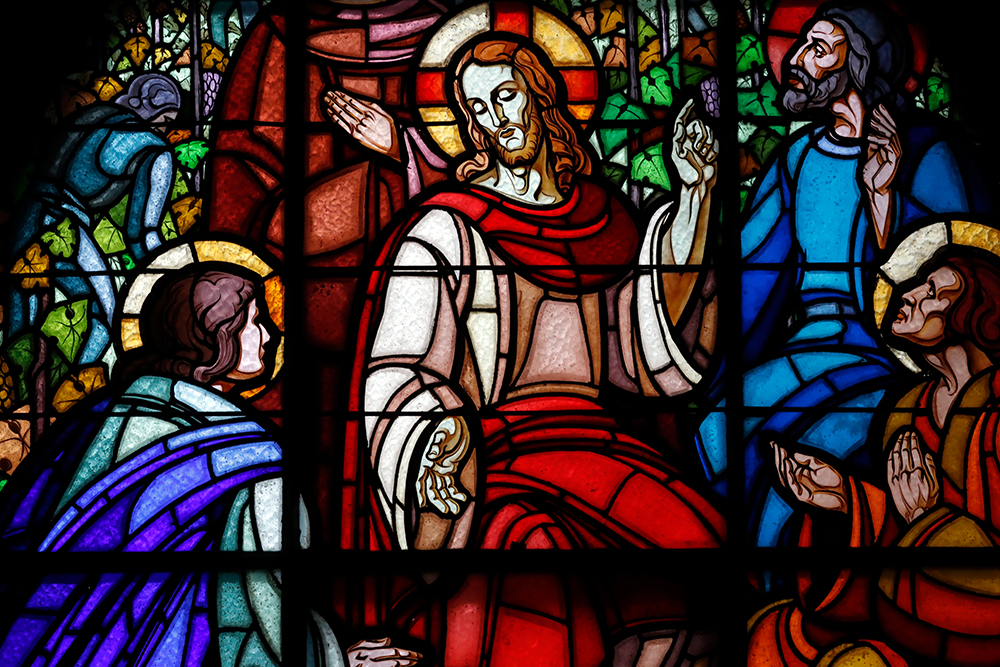
In today’s gospel, Jesus says, “Where I am going you know the way.” Our Lord is ascending to the Father in Heaven to prepare a place for us—his friends. Those for whom he has given up his life.
St. Thomas—speaking on behalf of the disciples—replies in a very understandable manner. “Master, we do not know where you are going; how can we know the way?” This statement and question, both, has the ring of accuracy even to the present day. We don’t know where Jesus is going. We don’t know where he is. Many try to follow Jesus, but the following of Jesus does not seem to have any clear direction. There are scores of different—and not only different, but also conflicting, contradictory—accounts of what it means to follow Jesus. The Catholic Church teaches, for instance, that certain religious practices (e.g., Sunday Mass and regular confession) are essential to the following of Christ. Other voices, however, endorse a less-formalized approach to the living of Christ (e.g., spiritual but not religious ways of Christian living). Still others argue that some of Our Lord’s teachings are now outdated; indicative more of the mores of something like first-century Palestinian culture than they are of a sincere and genuine following of Christ.
How can we be certain, then, about where Jesus is and how we are to follow him? And why is Jesus, seemingly, so silent? Would it not be better were he to speak even today and to point us in the right direction—point out to us the truth about who he is and where we can find him?
There is no denying that complexity, diversity, and contradiction characterize the contemporary moment. The unprecedented ability of people from around the world to be in contact with each other has not facilitated a more tranquil and simple form of human existence. Quite the contrary. Things like the internet, smartphones, and social media have overwhelmed us with information, ideas, and opinions. We want clarity. There are some who have sworn off the digital age—returning to more analogue ways of communication, learning, and life. Why? Sometimes fewer words communicate more powerfully—and truthfully—than many and varied words.
Nothing can replace direct and personal contact and communication. And this is supremely true in the case of Our Lord, Jesus Christ. He responds concisely, pithily, and truth-fully: “I am the way and the truth and the life. No one comes to the Father except through me.”
This response is well-known, but it has not always satisfied those who hear it. Jesus identifies himself as the way. He is the truth. He is the life. And yet there remains a plethora of others who point to the way, truths, and different lifestyles as consonant with what Our Lord did and who he is. The evident problem with this response is that it does not provide a cipher through which everyone can cut through all of the divergent claims about what it means to follow Jesus.
But this is precisely the point. Jesus gives us the answer to the human problem—not to the modern problem. The gospel precedes the complexity of a given age. Therefore, the proper way to negotiate the divergent claims of contemporary religion and spirituality is precisely in relation to what Jesus says about who he is. We can understand our contemporary chaos only in reference to Our Lord’s simple teaching. Our Lord’s words cannot be reduced to something like an interpretive matrix through which to understand current events. Rather, his words point to himself.
The fact is this: Our Lord and his holy teaching are too simple for those who enter into the complexity of different perspectives, viewpoints, and truth-claims. And this is why his message is so efficacious—even today. Our Lord is not a public intellectual. He is not offering one viewpoint (or “perspective”) among many. He does not shape his message to suit the fancies of his listeners. He offers something much more important and transformative than any tentative alternatives. He offers us himself—he is the way, the truth, and the life. And he does not change. Therefore, no matter what does change, Jesus remains who he is. And who is he? He is the Savior of the world—the Lamb of God who takes away the sins of the world.
Where is Jesus? He is now where he was before St. Thomas and the disciples. Right in front of us. Jesus is present to all who seek him. And his “real presence” lies at the center of the Seven Sacraments of the Catholic Church.
Where is Jesus going—and how do we follow him? There is no way other than Our Lord himself. This means that all salvific roads lead to Jesus. Jesus is not a means to something other than himself. He himself is the beginning, the middle, and the end of the Christian life.
We will be disoriented and confused if we look to Jesus for things other than Jesus. If, however, we look to Jesus to find Jesus then we find all things in him—we find nothing less than the way, the truth, and the life. We find our Savior.