
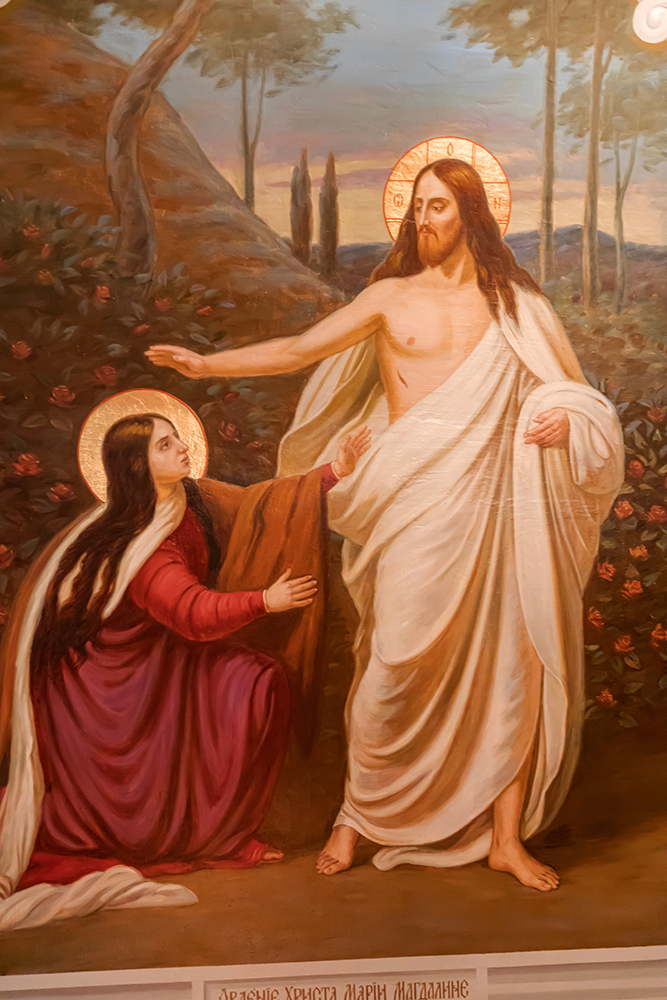
Today’s gospel—on the holiest day of the entire year—recounts events that happen on “the first day of the week.” Easter Sunday. Reality is fresh. Christ has made all things new. Nonetheless, the gospel also notes that things remain shrouded in darkness because it is still “early in the morning.” In other words, Our Lord has ushered in a new day, but things are not yet fully visible under the new day’s light. Therefore, this Easter Sunday gospel reading paradoxically combines a newness—a freshness—with a still-lingering darkness.
And it is within this paradoxical combination of elements that Mary Magdalene searches for Jesus. She has consecrated herself with the utmost devotion to Our Lord and Savior. The problem, however, is that she does not know where he is. This dynamic—an earnest search for Jesus conjoined to lingering confusion about where he is—can characterize the ordinary Christian life. We want to find Jesus—we go to Church, we pray, we make resolutions—and yet we can often feel as if he is hiding. We can feel as if the darkness shrouds Jesus. “Where is Jesus?”
Like Mary Magdalene, however, the saints do not give up their search for Christ because they realize that the “darkness” of our present life—a darkness that can make Jesus difficult to see—is a very specific kind of darkness. The full spiritual illumination of the “sun” has not yet arrived. Nonetheless, this present darkness—the specific kind of spiritual darkness that characterizes the spiritual life—is a uniquely Christian darkness. It is very different from all other types of darkness. How so? As the Gospel explains, ours is the darkness of the Christian morning. The sun is coming. The darkness is passing away; it is not arriving. The light of salvation is on the horizon. The shadows are fading away, and the light of Christ is here.
A certain obscurity—a certain “darkness”—does, indeed, characterize the Christian life. Nonetheless, this darkness, the darkness of faith, is not final or ultimate or complete. The luminous glory of God is here. We Christians live, even now, in the “morning” of Christ’s saving presence. As Our Lord promised, he is really and truly present with us—even until the end of the age—in the Sacraments. Our Lord has not abandoned us. He is here.
Nonetheless, we are not yet in Heaven. We are still wayfarers on earth, making our way to beatific glory through the theological virtues of faith, hope, and charity. We presently experience the paradox of being fully united to our Lord Jesus through the sacraments, and yet not seeing him face to face as we will in the Beatific Vision of the next life. Therefore, we journey throughout the Christian life in a way similar to Mary Magdalene. We search for Jesus while not fully seeing him as he is in himself.
In this life, we live by faith and not by sight. Nonetheless, the obscurity of faith—not being able to see Jesus face to face—is not something that should cause us chagrin. For the darkness of this life is a darkness much like the darkness of the pre-dawn morning. It is a darkness that is fading away… a darkness that is ever-ceding to the glorious radiance of Christ.
Although we cannot see Our Lord’s divine presence with our own eyes, Jesus sees all things. He sees the graces that he really communicates to human persons even in this life. He knows what we need. All is radiant to him. And soon—in heavenly glory—his light will be our light.
Therefore, let us cling to our Lord unwaveringly in our quest to be united to him. Let us draw consolation from the fact that the light of heaven is real—and that it is coming for all those who are faithful. The “light of glory” (lumen gloriae) is on the heavenly horizon (see CCC nos. 954, 1028). Ours is not an obscurity or a darkness of the night of death and sin. Ours is the darkness of the morning. Salvation has come. Jesus is here. The light of heaven is upon us. Alleluia!