
Jesus came to this Earth as a human to descend into our sinfulness, and raise us to perfection. His preaching, teaching, and healing ministry greatly affected those He came in contact with. However, because He took on our human limitations, He could not reach all people in all places. So after His ascension to the right hand of God, He left us His Church and gave Her the sacraments. As a result, the whole world could be invited into the love of God and participate in His healing actions.
No sacrament exemplifies this more than the Eucharist. In the form of bread and wine, Jesus gives us His Body and Blood in which His soul and divinity are present. His presence that He leaves with us animates the Church through a communal, life giving meal.
Jesus was very intentional when He gave us the Eucharist. He was at arguably the height of his fame when He made the assertion to the crowds that He is the Bread of Life and that no one could have eternal life unless they ate His flesh and drank His blood. Even when the people were revolted at the idea, Jesus emphasizes what He says and allows all of the disciples and crowds to leave him over this teaching. This left only His apostles as His followers who still did not understand Jesus’ words, but put their faith in Him.
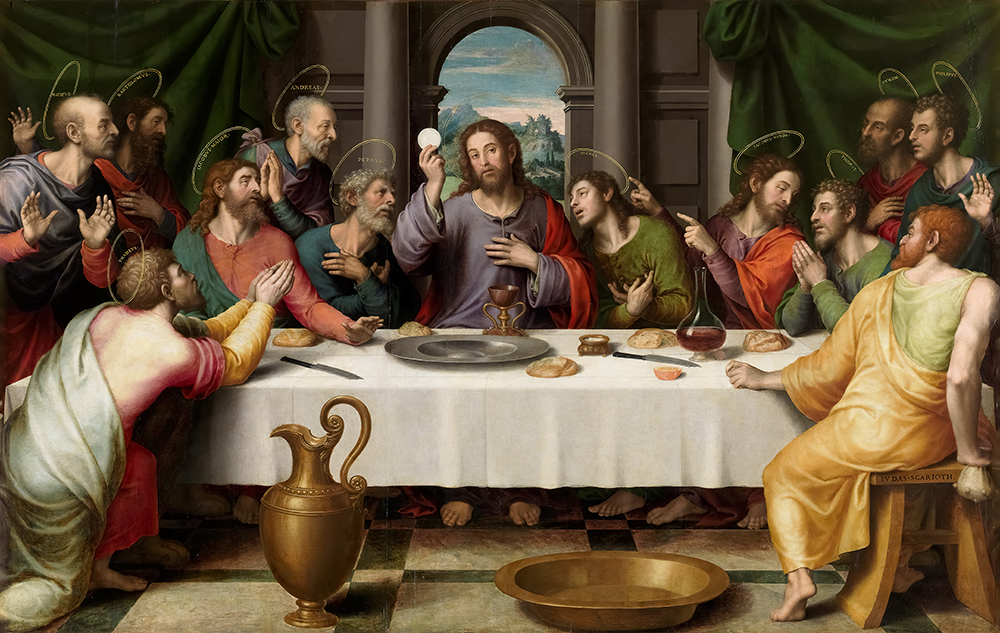
Because of their faith, Jesus gave the Eucharist to His apostles first. When he celebrated the Passover meal on the night before he died, Jesus took bread, said the blessing, broke it, and giving it to his disciples said, “Take and eat; this is my body.” Then he took a cup, gave thanks, and gave it to them, saying, “Drink from it, all of you, for this is my blood of the covenant, which will be shed on behalf of many for the forgiveness of sins. He exhorted them to do this in remembrance of Him.
In doing this, Jesus sacramentally gave the Church His body and blood for all generations. He did this so that all people could have access to the literal sacrifice of His body and blood that took place at the hands of the Jews and the Romans in the next twenty-four hours. Then, on the evening of His resurrection, Jesus again celebrates the Eucharistic meal with the disciples on the road to Emmaus. It is only when He disappears after His breaking of the bread that Jesus is recognized by the disciples after spending hours with Him. Jesus’ salvific action bookended by the Eucharistic meals signalled that Jesus’ death was a willing sacrifice, not just a victim’s unjust execution.
These biblical passages show us that when it came to the Eucharist, Jesus was very intentional and very literal. As the Eucharist is the source and summit of the Christian life, it makes sense that Jesus would be explicit in His institution of the sacrament. We need the presence of God to change our sinful natures to who we are meant to be, and the Eucharist is given to us because it encapsulates the very action in which Jesus conquers sin. When we gather around the Eucharistic table, we partake in Jesus’ body and blood not only as a source of unity for the Church, but so that all may have life in abundance.