
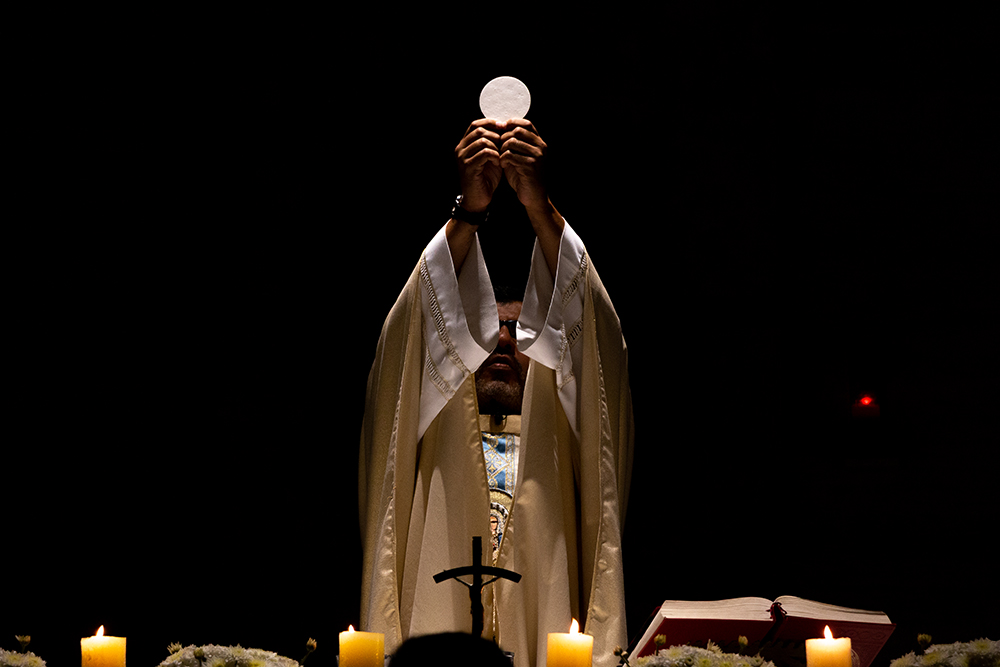
The sacrament of the Eucharist is the source and summit of the Christian life because it is the body, blood, soul, and divinity of Jesus. He gives us His presence in the form of bread and wine and commands us to celebrate the Eucharistic meal in memory of Him so that we can be made one in His Body. Yet, the Eucharist is a source of division amongst Christians across the globe. While the Catholic Church continues to proclaim the true presence of Jesus in the sacrament, many protestant and nondenominational Christians reject the Church’s seemingly fantastic teaching. To many, the teaching on the Eucharist seems to be an exaggeration or a too literal interpretation of scripture that leads to idol worship. Yet, if we delve deeper into scripture, we find that God has been very intentional in revealing His plan for the Eucharistic meal.
The first significant prefiguration of the Eucharist is found in the book of Genesis when Abram saves his nephew Lot and the cities of Sodom and Gomorrah from their enemies. Upon Abram’s victorious return, a mysterious king named Melchizedek offers a sacrifice of bread and wine and then blesses Abram. Melchizedek is revealed to be a priest of God the Most High.
Melchizedek is a prefiguration of Jesus and His Eucharistic sacrifice. Melchizedek was king of Salem whose name is translated to ‘peace’. It was the city that eventually became Jeru‘salem.’ Thus Melchizedek, the King of Peace of the region where the Last Supper took place, offers bread and wine as priest of the God Most High. Additionally, Psalm 110 (written hundreds of years later) will prophesy that the Messiah will be a priest forever of the line of Melchizedek, not the line of Levi (the line of the Jewish priesthood). Jesus, who is from the line of Judah, takes up this mantle with the sacrifice of His Body and Blood that he offers in the Eucharistic form of bread and wine.
Another significant prefiguration of the Eucharist occurs in the book of Exodus when the first passover occurs to deliver the Israelites from the slavery of Egypt. God sends the Angel of Death to kill all of the first born in Egypt as the tenth and final plague to convince Pharaoh of His superior nature. In order to save the Israelites from this fate, God instructed all households to take an unblemished lamb that is of age, sacrifice it, and apply the blood of the lamb to the doorposts and lintel of the house as a signal to the Angel of Death to pass-over the house because a sacrifice had already been made. Then they were to eat the meal of the lamb with unleavened bread while they were dressed for a journey because that night, God would deliver Israel from the land of Egypt.
When Jesus institutes the Eucharist at the Last Supper, He does so within the context of the Passover meal. By doing so, He is signalling to His disciples that He is the true passover because His bloody sacrifice on the wood of the cross would save God’s chosen people who participated in the Eucharist from the slavery of sin and death. His perfect, or unblemished, nature was the expiation of our guilt.
Another significant Eucharistic prefiguration occurs not long after the first passover when the Israelites had been saved by God defeating Pharaoh at the Red Sea. They began to wander the wilderness and were in search of food. God graciously provided for them by giving them manna which was bread that came from heaven nearly every morning. For forty years, this thin bread that formed like dew on the grass was the sustenance of Israel until they made it to the promised land. In the same way, at every sacrifice of the mass, God sends His Spirit that descends on the gifts of bread and wine like the dewfall so that it becomes for us the Body and Blood of Jesus Christ, the true bread from heaven that sustains us on the journey to our heavenly promised land.
There are many other prefigurations hidden and not so hidden within the rich depths of the scriptures. The Jewish Todah offering, the bread of presence in the Jewish temple, and Isaiah’s vision of a burning coal are just a few references that point us to the marvelous gift of Jesus’ body and blood. But despite these and countless other illusions, we will not truly believe in the true presence of Jesus in the Eucharist unless we see with the gift of faith. When we are open to receiving this gift from Jesus who opens the eyes of the blind, we will be unified with Jesus and all those who receive His body and blood.