
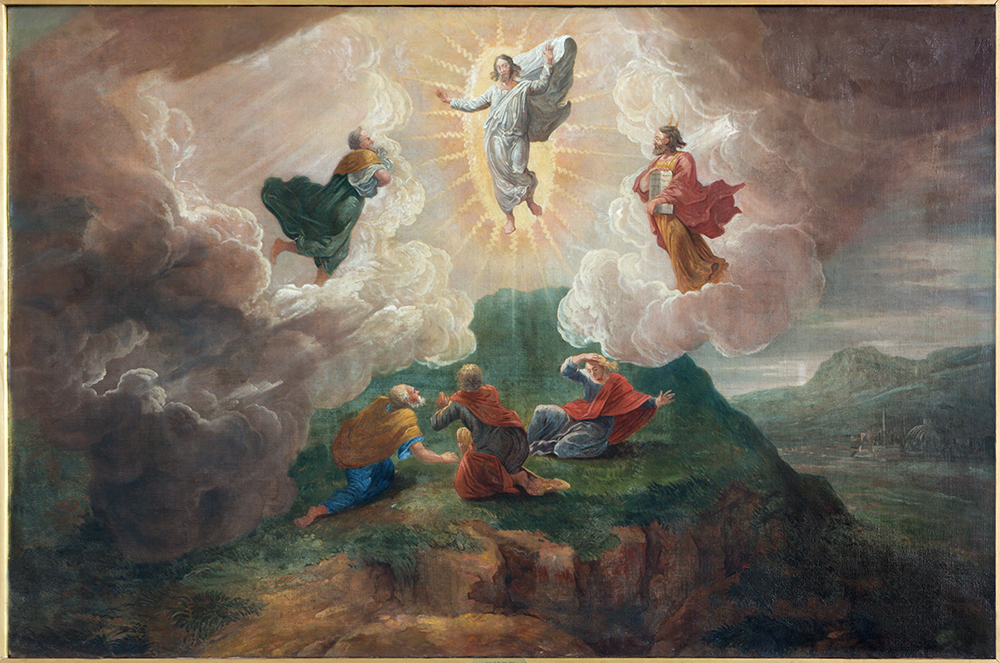
In today’s Gospel, the disciples Peter, James, and John experience a tremendous encounter with the unveiled glory of Our Lord Jesus. The Gospel says, “He was transfigured before them; his face shone like the sun, and his clothes became white as light.”
It is interesting to observe that none of the disciples manifest any fear or trepidation during this awesome encounter with the transfigured Lord. They are drawn to this experience of the Son’s glorious self-revelation. Indeed, the disciples wish to remain in the glory of this experience, such that St. Peter says to Jesus, “Lord, it is good that we are here. If you wish, I will make three tents here, one for you, one for Moses, and one for Elijah.”
The Transfiguration did not intimidate or overwhelm Peter, James, and John. Quite the contrary, they wished to remain in this experience. They wanted to remain in this glorious encounter forever.
We can understand, even in our own daily Christian lives, the disciples’ instincts. It is not an uncommon thing to desire that the Jesus who appears on the altar under the appearances of bread and wine would manifest his glory to us in a way analogous to what these three disciples experienced on the high mountain. We know and believe that Jesus is truly present in the Most Holy Sacrament of the Altar—Body, Blood, Soul, and Divinity—and yet the full splendor of his glory eludes us. He is not transfigured before us during the Mass. We know that Jesus transubstantiates bread and wine into his Body and Blood, but we can sometimes yearn for something like a transfigured manifestation of his heavenly glory.
Much like Peter, James, and John, then, we too would like to experience the transfigured Lord. Sometimes it can feel like the Real Presence is not enough.
What is interesting, however, as we continue to consider the words of today’s Gospel, is that the disciples become overwhelmed and indeed fall prostrate—“very much afraid”—when the voice from the heavenly cloud says, “This is my beloved Son, with whom I am well pleased; listen to him.” It is at these words—and not before—that the disciples are overwhelmed and fearful. It is not in the presence of the transfigured Lord that they are afraid. Rather, they fall to the ground in fear when the Heavenly Father reveals his relation to Jesus and our relation to Jesus.
The Eternal Son is the beloved Son of the Father. Jesus the one who enjoys the good pleasure of the Heavenly Father. And the disciples are commanded to “listen to him.” These personal words—words not just about Jesus in himself, but words about Jesus in relation to the Heavenly Father and to the disciples—overwhelm them, and they cover their faces.
Jesus, however, draws near and touches them, saying, “Rise, do not be afraid.” And The Gospel says, “When the disciples raised their eyes, they saw no one else but Jesus alone.” The Savior with them. Alone.
This same Jesus, although he does not transfigure himself before us in the sacraments, truly comes and touches us through each of the Seven Sacraments. This same Jesus is the same Lord in whom the Heavenly Father is well pleased and to whom he instructs us to listen—even today. This same Jesus recognizes that the command to listen to him—to be conformed to him, to devote ourselves to him, to find our identity in him—can overwhelm us. He recognizes our inadequacies, our brokenness, and our sinfulness. And yet this same Jesus continues, through each of the Seven Sacraments, to approach us in love, to embrace us with his healing touch, and to invite us to rise in him and to be afraid of nothing when we are united to him.
Today’s Gospel, thus, teaches us that Our Lord’s heavenly glory is not a reality meant merely to “impress.” The Lord Jesus does not come to elicit mere admiration. He is not a spectacle for us; rather, he is Our Savior—the Savior who came to draw us to himself. And he invites us to something more intimate than mere observation or extrinsic consideration. He invites us to real union with himself. “This is my beloved Son… listen to him.”
In conclusion, although the full refulgent glory of Jesus is not visible to us, he is truly present to us through the Seven Sacraments of the Church. Jesus never withholds himself from those whom he loves. He was not any more “real” to the disciples on the mount of Transfiguration than he is to us in the Sacraments. And even today he comes to us, touches us, and says to each of us—individually and personally—“Rise, do not be afraid.”