Once when I was younger, I was asked to give a talk at a high school retreat. I crafted the message that I wanted to give, and began to make an outline. I knew that every good talk is supported by scripture, so I then searched Bible verses on the internet pertaining to my topic. I found a multitude of options, but each verse seemed to only partially back the thesis of my talk. Again and again I looked for a way to make the Bible verses fit, but thankfully my objective honesty told me that none of them would work, so I abandoned having scripture in my talk altogether. I am unsure on how the talk was received, or if it was any good. It was a very long time ago. But what I see in my young self was the same pitfall of the Pharisees in today’s gospel.
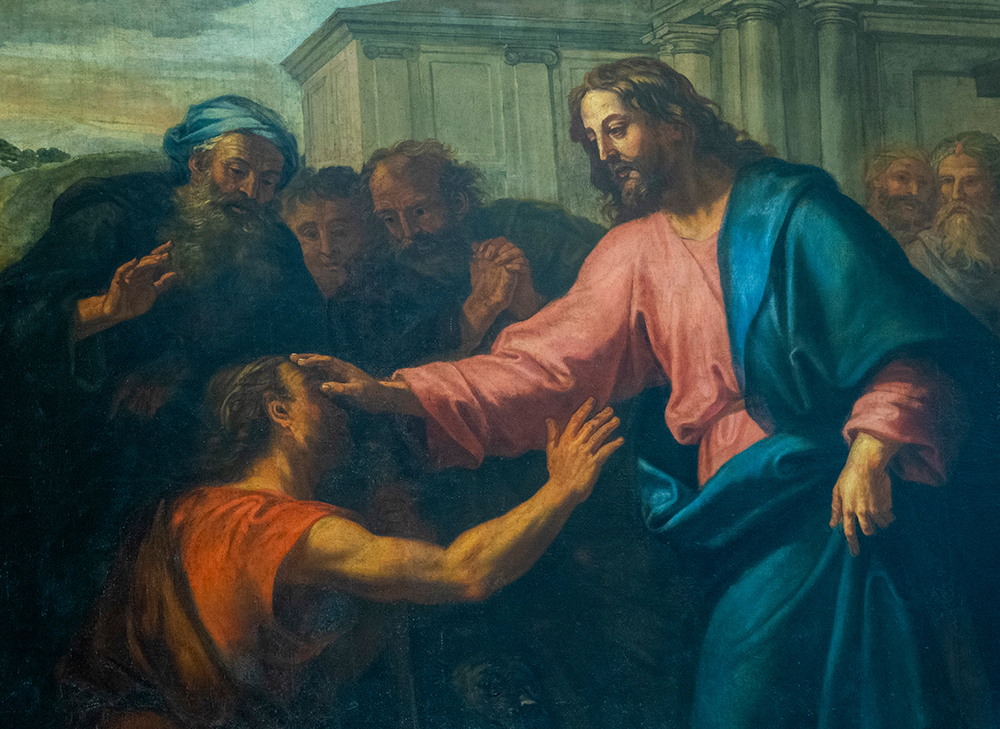
In Jerusalem, a man that had been born blind was healed by Jesus on the Sabbath. Frightened and threatened by Jesus’ power and His seemingly cavalier attitude toward the commandments, the Pharisees went on a witch hunt to get to the bottom of the apparent violation of God’s law. They go from questioning the man who had been healed, to questioning his parents, then back to questioning the healed man. At each step of the way, the Pharisees were looking for information that would support their narrative that Jesus is a heretic and a threat to the Jewish faith. Yet, they are unable to gather the evidence to support their bias. The man born blind is able to refute their claims, and then Jesus himself is able to point out their blindness.
In the blind man, we see the wisdom of God that raises the lowly above kings and princes. It is the same wisdom of which David writes: I have more insight than all my teachers, because I ponder your testimonies. I have more understanding than my elders, because I keep your precepts. The Pharisees had their agenda. They knew the Law of Moses. They knew the Prophets. But for too long, the people of Jerusalem had co-opted God’s Word to fit their narrative and rationalize their sinful dispositions. So when they encounter God’s Word incarnate who did not fit their narrative, they looked for evidence to refute and condemn Him. But none could be found.
This leads us to the attitude of Jerusalem during Holy Week. When the Word of God seems to not support us or even refute our way of life, in our pride we often rid ourselves of it. I exemplified this attitude whenever I left Bible verses out of my talk. If they were not going to fully support my message, I wanted nothing to do with them. The Pharisees do the same. Jesus doesn’t fit into their understanding of the Mosaic Law, so they looked for a way to condemn Him and all who supported Him. As a result, this incident and many others like it, led to the crucifixion, torture, and death of Jesus.
As we continue down the home stretch of Lent, we must ask ourselves: Where in our lives is God asking us to be humble to His Word and His Spirit? Our souls are in restless rebellion until we recognize that we need to conform our reality to God’s universe and not vice versa. He is calling us gently everyday to die to our own agendas to pick up our cross and follow Him. And while this is a scary proposition, we can be assured that His yoke is easy and His burden is light. For the wisdom that surpasses all understanding is found not in carrying out our own agendas, but in loving humility to our Heavenly Father