
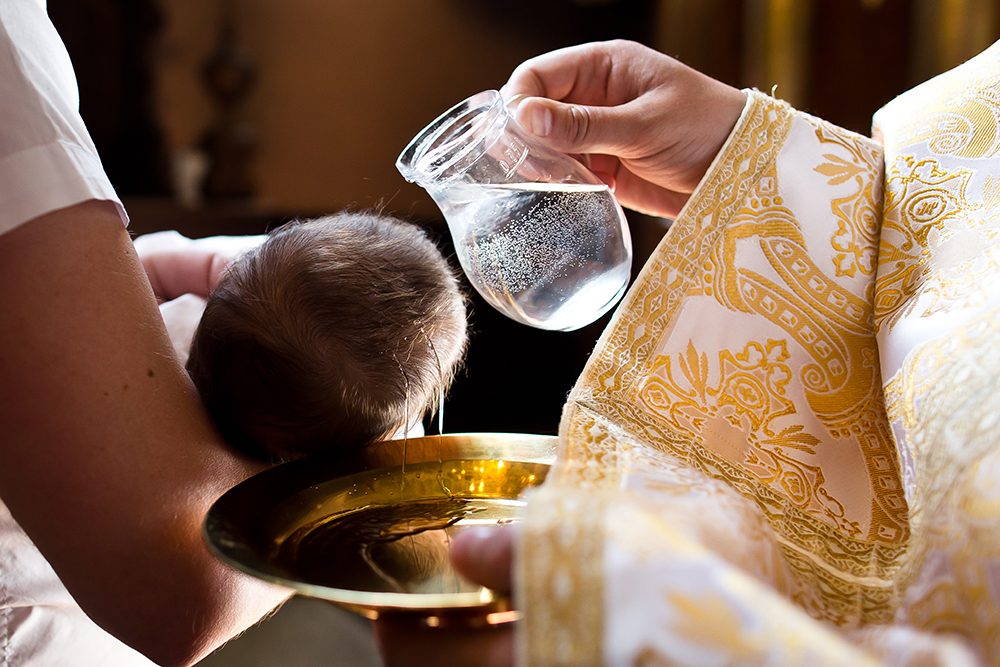
Baptism is the sacrament that welcomes us into the life of the Body of Christ, or the Church. It is a gift, given to us by God, that allows us to be born again of water and spirit so that we can take on Jesus’ divine life and receive His divine inheritance as a son or daughter of God.
Jesus entrusted the sacraments to the Catholic Church to pass them on to all generations who believed in Him. As a result, the Church has dogmatized the formula for Baptism that draws its roots from Jesus, John the Baptist, and the Apostles.
The matter, or physical thing that needs to be present for a sacrament to take place, of the sacrament of Baptism is water. John the Baptist was not the first person to baptize in the Jewish culture, but he was certainly the most famous. From his example of baptizing in the river Jordan and from the many people who underwent ritualistic cleansings of repentance, water became the symbol of being made clean in the eyes of God. Jesus confirms this when He himself is baptized in water and states our rebirth needs to come from water and Spirit.
The form, or actions and words that need to be present for a sacrament to take place, of the sacrament of Baptism is the minister saying, “I baptize you in the name of the Father, the Son, and the Holy Spirit,” while the person’s head makes contact with water three times. These words are known as the Trinitarian Formula and are given to us by Jesus right before He ascends into heaven during the discourse known as The Great Commission. During these words, the person being baptized can either have the water poured over their heads three times by the minister in a process called affusion, or they can have their head dunked under water three times by the minister in a process called immersion. In the early Church, immersion was much more common as the first disciples often baptized in cool running water, but today affusion is more common as a child or adult is baptized near a baptismal font in a Church.
The ordinary minister of the sacrament of Baptism is anyone who has undergone the sacrament of Holy Orders. A Bishop, Priest, or Deacon normally has the sacramental faculties to confer Baptism to those seeking a new life in Christ. However, in extraordinary circumstances (cases of emergency), anyone can baptize as long as they have the correct matter (water), form (Trintarian Formula spoken while contact of the water with the forehead), and the same intention as the Church. This means that even the un-baptized may confer the sacrament in emergencies if they are educated and humble enough to have the same intent as the Church. However, a person is not able to baptize themselves.
There is also the need of those who are being baptized to be prepared to live a life in the Body of Christ, the Church. While extensive preparation is not essential for Baptism to take place, it is required that a person or their spiritual authority understands what they are undertaking whenever they are baptized. For an adult, this means assenting to the person of Jesus as their Lord and Savior and having the intention of living a life of repentance in God’s love. For a child under the age of reason, the parent or guardian of a child promises to raise the baptized in the faith of Jesus. Once they become of age, the baptized is then called to take ownership of this faith.