
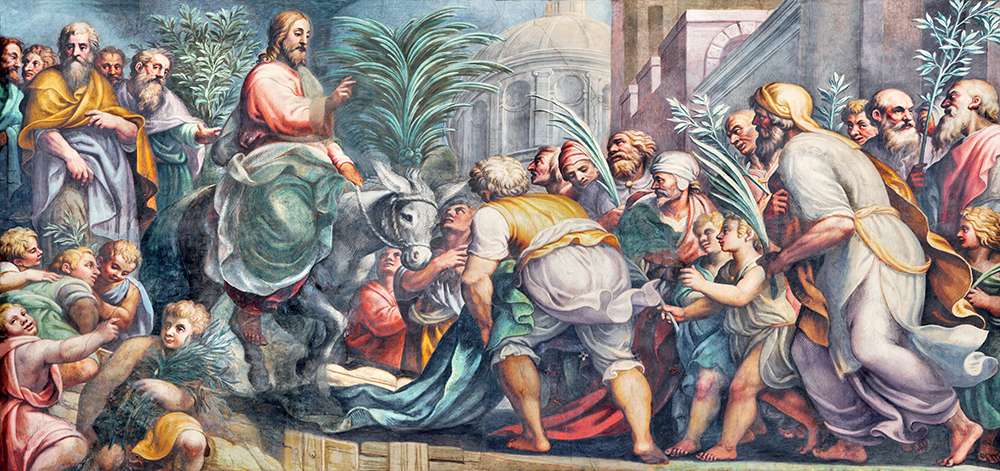
On this Sunday of the Lord’s passion, we have two Gospel readings. The first occurs before mass as we recount Jesus’ triumphal entry into Jerusalem. The second takes place in the gospel’s traditional spot, after the first two readings and the psalm, and recounts the story of the Last Supper, Judas’ betrayal, and Jesus’ trial, torture, and crucifixion. The gospel ends with a Roman Centurion, a pagan, proclaiming the crucified Jesus as the Son of God. On this note, we enter into Holy Week, reflecting on the consequences of our sins and God’s great love for us.
How could this happen? How could the human race kill the only Son of our beloved Creator? The simple answer is lack of faith. The people of Jerusalem did not believe in Jesus. Many people found interest in Jesus, and even admired him, but when Jesus entered Jerusalem the whole city was shaken and asked, “Who is this?” In reply, the crowds who were welcoming Jesus announced “This is Jesus the prophet, from Nazareth in Galilee.”
We must note that this is high praise for Jesus, but it is not high enough. Jesus is the Messiah, and as Simon Peter professed, He is the Son of the living God. So whenever we wonder at the audacity of Jerusalem and its governors to put Jesus to death, we must understand that they fundamentally got who Jesus was wrong, or at least not fully correct.
But since the people believed that Jesus was a prophet, we must ask the question, how does Jerusalem treat true prophets of God? Usually the prophets are persecuted and/or killed. Zachariah was stoned in the court of the temple, Isaiah was said to be sawn in half, and Jeremiah was thrown in a pit and died in exile when Jerusalem fell to the Babylonians. So if the people regard Jesus as a prophet, it is little wonder that He suffers the same fate as those who preceded him. Jesus even tells the parable of the vineyard that foretells his fate.
But why does Jerusalem act this way? This was the place where God was said to reside with his people. There was no mountain that God loved more than Mt. Zion. Should not the people who lived there receive the prophets and God’s Son with joy?
Theoretically, yes. But even though Jerusalem was physically built as the City of God, it was really a City of Man in the hearts of its residents. Since the time of Cain, the first murderer, a city became the first place of culture and the arts, but it was also a breeding ground of domination and violence. After murdering his brother, Cain is not allowed to provide for himself off the land. He has to resort to having others provide for him. But rather than depending on other’s generosity, Cain builds a city and takes what he wants by force. His descendents follow suit.
From that time on, the cities of the Old Testament are often opposed to God. Babel builds a tower in their pride meant to wage war on God. Sodom and Gomorrah desire to profane God’s angels. Pharaoh in Egypt openly defies God’s might. Anywhere people gather in large quantities, they degenerate into a society filled with oppression and strife.
God tries to lead the Israelite people out of the City of Man to the City of God by giving them the Law and His presence in the Ark of the Covenant residing in the Tabernacle Tent and eventually the Temple on Mt. Zion. But the people were constantly succumbing to the temptation of the surrounding cities and countries of modeling their society after the pursuit of amassing wealth and pleasure of idol worship. Thus, while Jerusalem was outwardly God’s city, inwardly they belonged to the violent city of man. As a result, when they encountered a true man of God, they reacted as Cain did when His brother Abel was blessed. They killed to remove the man who was directly opposed to their way of life. By the end of the Gospels today, Jesus suffers the same fate.
As we journey through this Holy Week, we are invited to examine what city we are building within our own hearts. Every time we sin, it is a type of crucifixion of Jesus. I am not saying that every sin of ours is equal to a nail in Jesus’ hand or a thorn in Jesus’ skull (although this can be a suitable reflection on sin). But I am saying that each time we sin, we remove Jesus from the equation either by redefining who Jesus is to fit our own desires, or by ignoring him completely. If our hearts love the way of the City of Man, we will be like Jerusalem and eventually eliminate Him in individual situations or completely from our lives. But if our hearts love the Word of God, we will have to face a great challenge: be crucified with Jesus. This is a tall task but the hope and consolation of this week is that if we die with Jesus in our hearts to the City of Man on Friday, we will rise with Jesus and receive the City of God on Sunday.