
Above and beyond. It’s a simple phrase we use to describe a person who does more than is expected of them, more than is required, or even more than necessary. It’s a phrase that summarizes the teaching of Jesus in the Gospel today. Our Lord takes the structure of the law, the plain meaning of the commandments, and calls on those who hear (or read) His words to go above and beyond. We can be righteous by following God’s law, it is true. But Jesus challenges us to see the more profound meaning of the commandments and to live them out in a more extreme way. There is no minimalism in the Gospel.
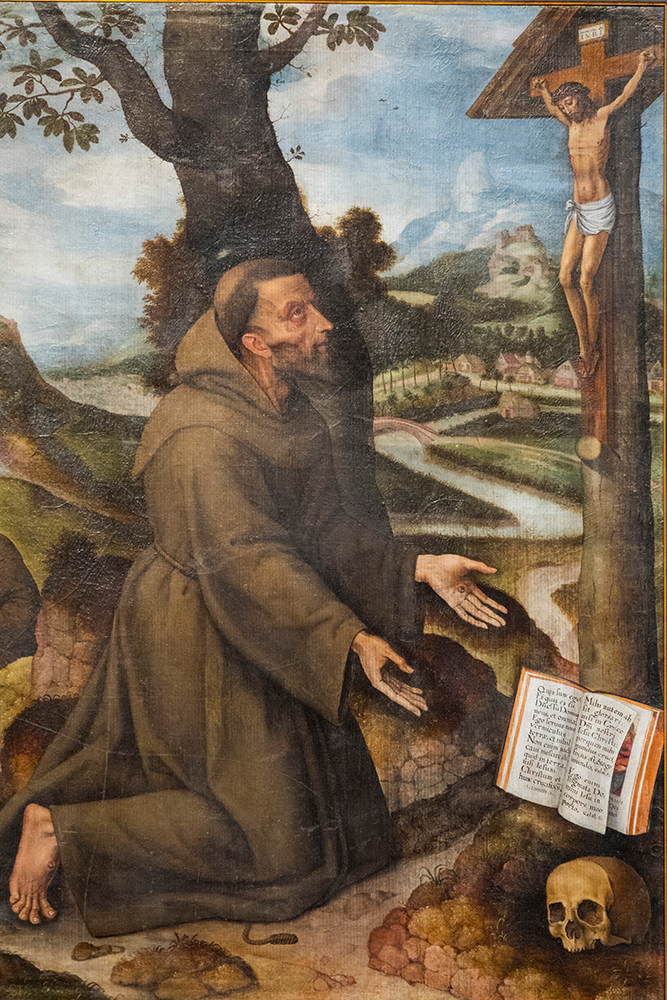
Pope Leo XIV recently announced a special jubilee year to mark the 800th anniversary of the death of St. Francis of Assisi. This great saint is more than just a nice decoration for your grandmother’s garden. St. Francis lived the Gospel, famously renouncing all his possessions so as to live in trusting surrender to Divine Providence in radical poverty. Francis, of course, was not the first saint to wonder what it would be like to live the Gospel as literally as possible. Centuries before, as he heard the priest reading the Gospel at Mass, St. Anthony was convicted that he should sell his possessions and give to the poor. Having done so, he returned to Mass the next day and was further convicted that he hadn’t gone far enough, and so he sold whatever he had left, made arrangements for his sister to be cared for, and then became a hermit in the Egyptian desert. Today we look at St. Anthony as the father of monastic life. Monks go above and beyond on behalf of the whole Church. Historically, St. Francis of Assisi came around at a time when the “above and beyond” spirit of the Church was in some trouble. His radical embrace of the evangelical counsels of poverty, chastity, and obedience helped spark a renewal that the Church sorely needed. One of those who helped kindle the flame of that renewal was a member of the order that St. Francis founded, and has become, perhaps, the more famous St. Anthony. Though he was from Portugal, St. Anthony is linked to the Italian city of Padua, where he became the first Franciscan priest to teach theology to his fellow friars (appointed for this purpose by St. Francis himself!). Far more than a helpful guide to find your misplaced car keys and glasses, St. Anthony of Padua is a radical example of devotion, service, and study.
Speaking of study, the Church has never doubted the value of education, especially insofar as our learning can help us reflect more deeply on the mysteries of God. But even study yields to the importance of evangelization. In a letter to his friend St. Ignatius of Loyola, St. Francis Xavier wrote, “Many, many people hereabouts are not becoming Christians for one reason only: there is nobody to make them Christians. Again and again I have thought of going round to the universities of Europe, especially Paris, and everywhere crying out like a madman, riveting the attention of those with more learning than charity: ‘What a tragedy: how many souls are being shut out of heaven, and falling into hell, thanks to you!’ I wish they would work as hard at this as they do at their books, and so settle their account with God for their learning and the talents entrusted to them.” He went above and beyond, preaching the Gospel in southeast Asia and bringing countless souls into life in Christ. Many years later, God would raise up another saint who saw souls in danger of being shut out of heaven. St. Frances Xavier Cabrini, undoubtedly inspired by her namesakes (the great Jesuit missionary St. Francis Xavier and the great poor man of Assisi, St. Francis) left everything behind in her native Italy in order to emigrate to the United States and serve the Italian immigrants who had no one to provide them pastoral care. Like St. Anthony of Padua, she taught them the faith, establishing schools, orphanages, and missions in New York, Pennsylvania, Illinois, California, Colorado, New Jersey, and Louisiana. She crisscrossed the Atlantic twenty-four times in order to secure the approvals and resources necessary to carry out her mission. Above and beyond.
I am no St. Francis of…well, any of them. It is easy to stay happily cocooned in front of my computer typing out a few hundred words, or ensconced in the safety of parochial routine. But the Gospel we read today challenges not just my (and our) moral commitments, it also points to the attitude necessary for living the Gospel most fully. There is no minimalism in the Gospel. For the love of Jesus, for the sake of proclaiming the Good News, we all have to go above and beyond. Each saint in the Church’s history has done just that, in their own particular place and time, according to their own particular gifts. In this time, in this place, with the gifts that God has given you, where does He want you to go above and beyond?