
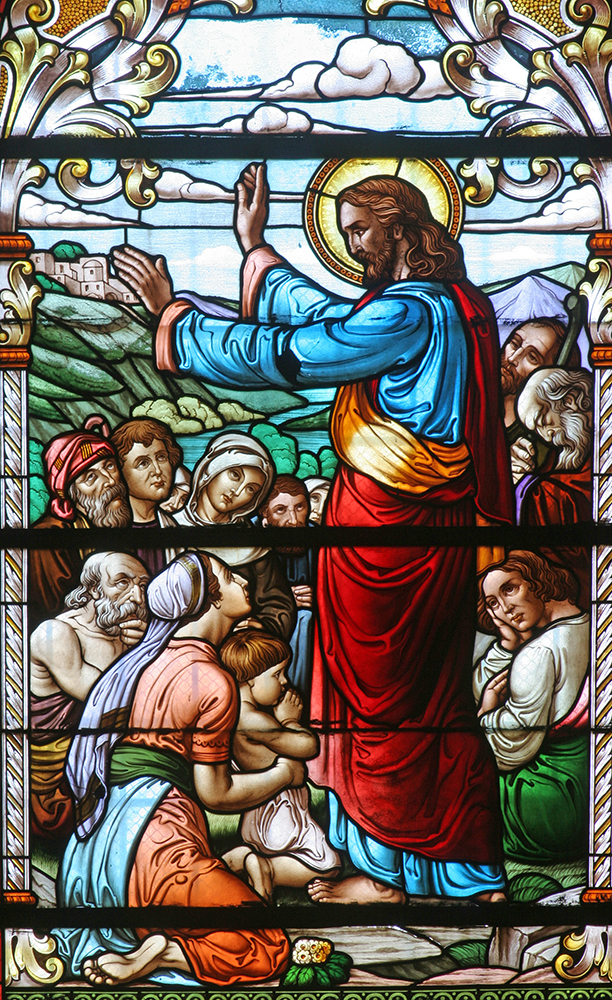
In today’s Gospel, we hear a passage from the famous Sermon on the Mount—and specifically and particularly the Beatitudes. Of the many things that Our Lord Jesus taught and revealed to his disciples, the Beatitudes are amongst the most famous and well known by all people, whether Christian or not.
The intriguing blend of spiritual sublimity and literary poetry that characterizes the Beatitudes has attracted attention since they were first spoken. This is one of the aspects of Our Lord’s holy teaching that has a wide appeal, because few, if any, of the Beatitudes are inimical to what our fundamental instincts are or what our common ideals might be. Everyone esteems peace and peacemakers. We all appreciate those who are meek and humble. Everyone prizes mercy and admires those who show mercy. We all admire purity of heart, and we can even recognize and respect those who endure persecution and suffering for the sake of their beliefs. In a word, everything that Jesus says in the Beatitudes has a natural appeal to most people. One need not be a Christian to approve of them.
But this is where we might make a mistake about the Beatitudes. And the mistake—although it can take many forms—is essentially this: we can mistakenly regard the Beatitudes as being merely something akin to human self-help adages that all people should follow. In other words, we can regard Our Lord’s teaching here as laying out natural aspirations that all human persons should strive to follow. This understanding of today’s Gospel, in effect, would reduce the essence and form of the Beatitudes to the terrestrial—to the human, to the natural—order of things. In other words, we can be very tempted to categorize the Beatitudes as things about us—things that we should do, ways that we should be, and behaviors that we should appropriate.
Such an understanding of the Beatitudes, although very common, would unfortunately reduce the salvific profundity of Our Lord’s teaching to the level of self-help guidebook for human life.
Of course, there is nothing wrong with regarding the Beatitudes as poetically intricate, practically significant, and universally appealing and relevant. The problem, however, is when we conclude that the Beatitudes are only beautiful life sayings. In other words, such a reductive conclusion about the Beatitudes would prevent us from appreciating fully their message, meaning, purpose, and the personal dynamics. And without such an appreciation, we would miss the real essence of the Beatitudes—nothing less than the Gospel itself.
In the Beatitudes, Jesus is not talking about abstract, elusive ideals that human persons can aspire to appropriate in their day-to-day life. Rather, he is speaking about himself.
Through the Beatitudes, Jesus gives to us, out of love, something precious, profound, and even saving. Namely, in the Beatitudes, Jesus gives us his own self-portrait. Jesus is not here talking about who we are in and of ourselves. Rather, Jesus is revealing who he is in and of himself. And who he is in and of himself is someone who loves us and came to give himself for us.
He is preeminently the meek one. He is the one who hungers and thirsts for righteousness—for our righteousness, for our share in his divine righteousness. Jesus is the one who is supremely merciful. He is the purest of heart. It is Our Lord who confers peace on all of God’s children. And he is the ultimate one who endured persecution for the sake of the kingdom of heaven—and he suffered in order that we might enter that kingdom and find our rest in him.
Thus, through the Beatitudes, Jesus is describing who he is in himself and who he himself is for us. Jesus came to give us—in love, gentleness, meekness, humility, mercy, and generosity—all that he is. And in the Beatitudes, Jesus is giving us his supernatural, yet preeminently accurate, self-description.
This does not mean, however, that the Beatitudes have nothing to do with us. Indeed, the Beatitudes are proper Christian formalities that shape the being and activity, the life and vitality, of all those who live in union with Jesus. But this is precisely the point. The Beatitudes in our lives are an effect of union with Jesus. They are not behaviors separate from him. We become what we are united to, and when we are united to the meek, peaceful, and merciful Jesus, we ourselves become like him. Having received from him who he is and what he does, we are conformed to Jesus and to those things that he himself is and does.
In conclusion, therefore, let us draw near to Our Lord of the Beatitudes. Let us thank him for coming—out of generosity, love, and mercy—to save us from our wretchedness and from our brokenness. May we cherish in gratitude the fact that Jesus came to give us his very self and to share with us his very (saving) identity.
And may we all cultivate the Beatitudes in our lives, not in and because of ourselves, but in and because of Jesus—who reveals who he is in and through these same Beatitudes.