
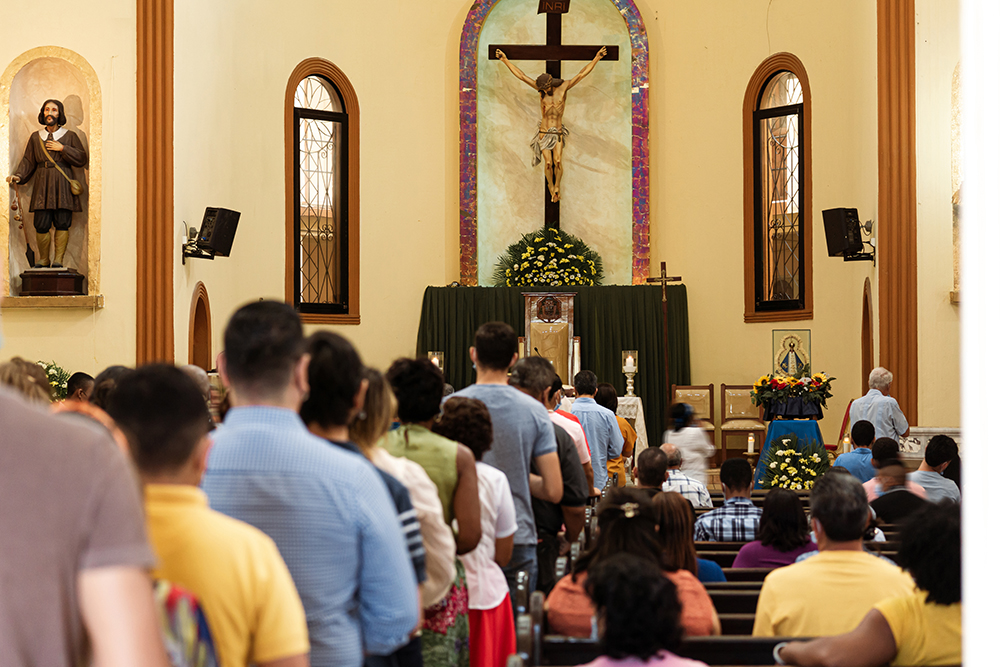
In today’s gospel, Our Lord gives us one of the most important teachings of the Christian religion. “I am the living bread that came down from heaven; whoever eats this bread will live forever; and the bread that I will give is my flesh for the life of the world.” This is a stupefying claim. Our Lord does not say that he gives us a mere “symbol” or “sign” of his presence or of our life in him. Rather, he reveals that his very flesh is the life of the world.
Understandably, his listeners receive this revelation with confusion and even some consternation. They unsurprisingly have a follow-up question. And this is a good thing: questions are not bad; they do not contravene the dynamics of faith or of salvation. What is noteworthy, however, is the type of question that Our Lord’s interlocutors ask. Theirs is a “how?” question. “How can this man give us his flesh to eat?”
Jesus does not get into the “how” of his real presence in the Eucharist. Instead, he reaffirms the truth of what he has revealed: “Amen, amen, I say to you, unless you eat the flesh of the Son of Man and drink his blood, you do not have life within you.” And in case there is any lingering doubt or confusion, he continues: “Whoever eats my flesh and drinks my blood has eternal life, and I will raise him on the last day.”
The Church has never denied that the “how?” question is interesting and important. As we know, the Church has identified the means through which bread and wine are changed into Christ’s body and blood as “transubstantiation” (see the Catechism of the Catholic Church, no. 1413). There is nothing wrong with the “how?” question. Nonetheless, the “how?” question is only relevant if it is true that Christ’s body and blood are really present in the Most Holy Sacrament of the Altar. And this is clearly Our Lord’s emphasis today.
The real presence of Jesus in the Eucharist is not an abstract, ethereal teaching. Our Lord does not want his listeners to get distracted from the real, concrete, and “salvation-al” importance of what he reveals about Holy Communion. He could not be clearer: “Whoever eats my flesh and drinks my blood remains in me and I in him.” Nothing less than our very salvation lies in our reception of the Eucharist: “Whoever eats my flesh and drinks my blood has eternal life, and I will raise him on the last day.” Our Lord’s emphasis, thus, is on what does the Eucharist does in—and means for—our lives? And the answer is simple: salvation. In the Eucharist we receive the Savior of love.
No one denies the importance of love. The importance of the dynamics of love is something upon which all can agree: it is essential for human existence, human community, and human happiness. There are many books, articles, and podcasts that talk about “how” to love. Such resources, of course, can be very helpful for those who wish to love. Nonetheless, sadly, we can also recognize that many loving relations, seemingly, fall apart in today’s world. Marriages end. Children are neglected. Communities are betrayed.
And it is precisely before such sad and painful instances of failures in love that Our Lord’s words about love are so important. If we do not receive love, we will eventually run out of love to give. Finite creatures like us are unable to love without end unless we constantly receive a love that never ends.
Jesus conforms us to himself through the sacraments. And as so conformed, we are transformed and able to live in a new way, namely, the way of Jesus himself—the way of love. Jesus can take care of the “how” of this transformation. He is God. Nothing is impossible for him. He can do what he says. We need to remember that this is true—that he gives us himself in the Eucharist.
There are so many people who do not go to Mass—who do not receive the body and blood of Jesus in the Eucharist, who do not receive the love of Our Lord. Families, marriages, friendships, and communities are suffering from an absence of love. Jesus has given us the source of loving nourishment. He gives himself to us in the Mass. This is the truth. And this fact is what Our Lord emphasized for his listeners in today’s gospel and what he continues to emphasize in our contemporary world and moment.