
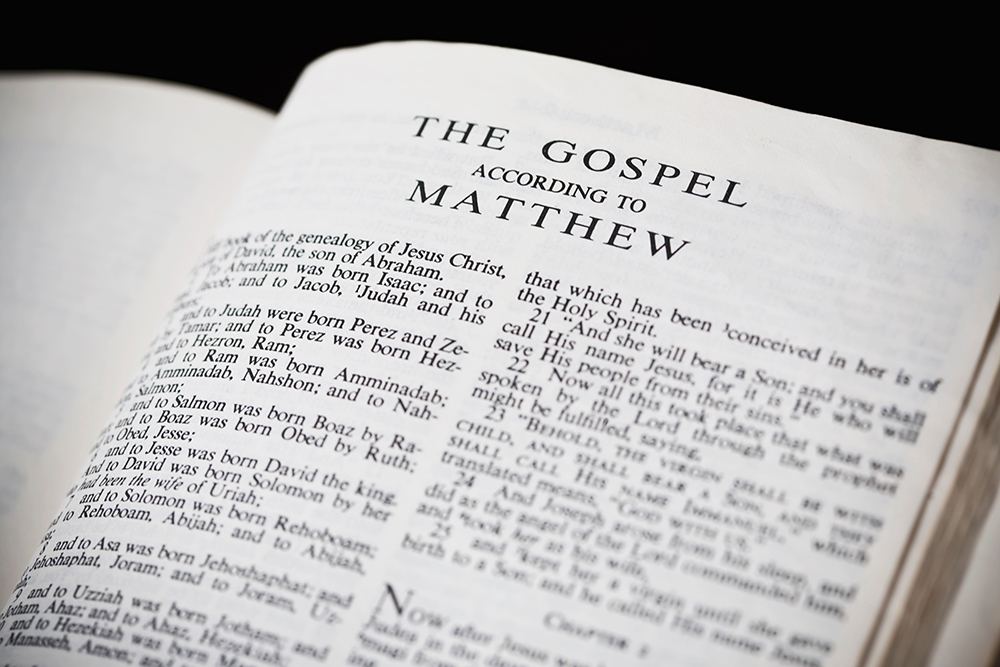
The Gospel of Matthew has always fascinated me. With its frequent and explicit references to the stories of the great heroes and great events of the Old Testament, it connects the ministry of Jesus and the mission of the Church with prior revelation more than any other New Testament writings. It was Matthew’s genealogy of Jesus at the very beginning of his gospel that also led me to wonder how far back I could trace my own genealogy, launching a favorite hobby. Matthew’s natural way of bringing together the Old and New Testaments led the Early Church to give it a certain priority. More than the other Gospels, Matthew dominates the commentaries, homilies, and catechesis of the Early Church Fathers. Given its importance and explicit connections to the Old Testament, it makes sense that this would be the book to open the New Testament.
The unanimous consent of Church Fathers who comment on it is that the Apostle Matthew, the son of Alphaeus, also known as Levi (see Mark 2:14), wrote this gospel. Matthew was a tax collector whose calling is recorded in all three synoptic Gospels (Matthew 9:9-13, Mark 2:13017, and Luke 5:27-32). Christian tradition explains that Levi was his birth name, and Jesus gave him the name Matthew, meaning “gift of the Lord” in Hebrew. As the son of Alphaeus, Matthew may have been the biological brother of James the Lesser, also son of a man named Alphaeus. This James is traditionally identified as the author of the Epistle of James (James 1:1), which shares many literary and theological ties to Sermon on the Mount written by James’ possible brother Matthew. The Gospel of Matthew very well may have been written in the A.D. 60’s or earlier, though many modern scholars posit the 80’s or later. Tradition has Matthew ministering near the Black Sea and the Caspian Sea before being martyred. In some traditions, he was martyred at the altar while celebrating Mass.
While Matthew presents some material similar to the other Gospels, there is much material that is unique to this gospel. Matthew’s infancy narratives, told mostly from the perspective of St. Joseph, round out Luke’s mostly Marian infancy narratives, and Matthew alone tells of the visit of the Magi (2:1-12). A large portion of the Sermon on the mount is unique to Matthew, as are many of Jesus’ parables. The Parables of the Wheat and Weeds (13:24-30), the Hidden Treasure (13:44), the Pearl of Great Price (13:45-46), the Net (13:48-50), the Unforgiving Servant (18:23-35), the Laborers in the Vineyard (20:1-16), the Two Sons (21:28-32), the Wise and Foolish Virgins (25:1-13), and the Sheep and the Goats (25:31-46) all are found only in Matthew. He is also our only biblical source for major events in St. Peter’s life: walking on water (14:28-31), the conferral of the keys (16:17-19), the temple tax discussion (17:24-27), and Peter’s question about forgiveness (18:15-22).
Matthew’s Passion Narrative includes details not found elsewhere including the death of Judas (27:3-10), Pilate’s handwashing (27:24-25), the mini-resurrection in Jerusalem (27:52-53), and the guard at the tomb (27:62-66; 28:11-15). Matthew alone ends his gospel with the Great Commission (28:16-20). Much of the material that Matthew shares with other gospels he presents in a uniquely Matthean way, most especially his version of the Beatitudes (compare Matthew 5:1-12 with Luke 6:20-26) and the Lord’s Prayer (compare Matthew 6:7-15 with Luke 11:1-4). From all this, we can discern three unique focuses of Matthew’s gospel: a special interest in interpreting the Mosaic Law in light of the Messiah’s arrival, the person and role of St. Peter, and the contrast between true and false discipleship.
Matthew presents the life and ministry of Jesus in a narratively balanced and structured way. Rather than plodding through a slavishly chronological account, he arranges material thematically. Even his prologue of infancy narratives presents a symmetrically balanced genealogy of Jesus beginning from Abraham (1:1) and broken up into three sets of fourteen generations. Jesus is born (1:18-25) and the magi visit (2:1-12) just before the Holy Family flees to Egypt (2:13-15) while Herod massacres the infants around Bethlehem (2:16-18). The prologue ends with the Holy Family’s return to Nazareth (2:19-23).
The heart of Matthew’s gospel that follows is arranged neatly around five distinct sections (chapter 3-7, 8-10, 11-13, 14-18, and 19-25) as a nod toward the Pentateuch, the five Books of Moses. Each section begins with a narrative of Jesus’ deeds and teachings and ends with an extended discourse that concludes with some version of “When Jesus had finished these sayings” (7:28, 11:1, 13:53, 19:1, and 26:2). In the first “book,” Jesus is baptized (3:13-17) and tempted in the desert (4:1-11) before beginning his ministry in Galilee by calling his first disciples (4:18-22) and preaching the Sermon on the Mount (5:1-7:27). In the second “book,” Jesus begins to show his divinity by performing several miracles including lots of healings (8:1-17, 9:1-8, 9:18-34) before giving the Mission Sermon (10:5-42) about the conditions of true discipleship. The third “book,” is marked by increasing focus on how people respond to Jesus as John the Baptist sends messengers just to make sure he is the Messiah (11:2-6), some towns remain unrepentant (11:20-24), and the Pharisees are angered over Sabbath healings (12:9-14) while Jesus is compared to Beelzebub (12:22-32). As the tension rises, Jesus begins preaching in parables with the Mystery Sermon detailing mysteries of the Kingdom (13:1-52). In the fourth “book,” animosity toward Jesus grows as John the Baptist is martyred (14:3-12) and Jesus challenges the tradition of the elders (15:1-20). Jesus responds by conferring the keys on St. Peter (16:13-20), predicting his Passion twice (16:21-23, 17:22-23), and being transfigured (17:1-8) before preaching the Mercy Sermon (18:1-35) about the Father’s desire to forgive sins. The fifth and final “book” details the climactic entry into Jerusalem (21:1-11), cleansing of the Temple (21:12-17), and subsequent verbal battles with the religious elites, concluding with the Mount of Olive Sermon (24:1-25:46), sometimes called the Eschatological Discourse on the end times.
To bookend these five sections, Matthew details the events of Holy Thursday and Good Friday before wrapping up his gospel with a brief Resurrection account. This beautifully balanced and structured account of Jesus’s life and mission concludes with a crescendo as Jesus gives his followers their marching orders: “Go, therefore, and make disciples of all nation, baptizing them in the name of the Father, and of the Son, and of the Holy Spirit, teaching them to observe all that I have commanded you” (28:19). In Matthew, we move from the ancient genealogies of Genesis into the mission of the Church in the modern world. It is no wonder the Early Church Fathers gave this gospel such a revered position among all the inspired writings that we call the Bible.