
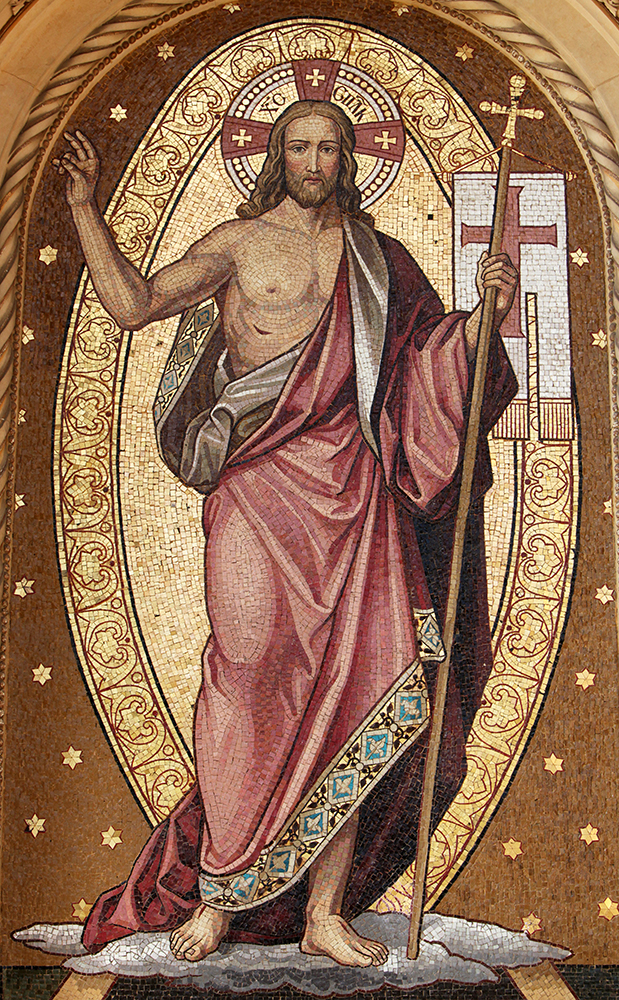
Jesus Christ is alive today, right now. That is the decisive claim at the heart of Christianity. It’s not some myth or fairytale. 2 Peter 1:16 puts it well: “For we did not follow cleverly devised myths when we made known to you the power and coming of our Lord Jesus Christ, but we were eyewitnesses of his majesty.” No, it’s not a myth. Everything in Christianity else stands or falls with the historicity of the Resurrection.
It was the definitive verification of Jesus’ claims to be divine, and if Jesus actually is who he says he is, then everything else he says carries supremely important weight. If Jesus actually is God, then all of his moral maxims matter. If Jesus actually is God, then when he holds bread and says it is his body, it must be his Body. If Jesus actually is God, then when he invests twelve guys with his own personal authority and the ability to teach and heal in his name, then the hierarchical Church is incredibly important. And if Jesus actually is God, then everything he told us about heaven and how to get there is the most important information in the history of the world.
It all hinges on the historicity of the Resurrection. St. Paul admitted as much: “If Christ has not been raised, then empty is our preaching; empty, too, your faith” (1 Cor. 15:14). So how does an intelligent person, laden with enlightened postmodern skepticism, reach the conclusion that this is more than a fairytale or a myth? What is the evidence? Here are four facts backed by so much historical evidence that most professional, critical scholars (including atheists) accept them as true.
- Jesus was a real, historical person who died by Roman crucifixion in the first century A.D. It is historically undeniable that Jesus was a real person. In the literary record, there is at least as much evidence for Jesus as there is for any ancient historical figure. He wasn’t a myth.
- Jesus’ closest followers were convinced that he rose from the dead and appeared to them. These men and women were so utterly convinced of this fact that they were willing to face, not fame and success for founding a new religion, but persecution and torture for promoting this idea. The eyewitnesses were completely convinced that this actually happened.
- Paul, formerly known as Saul of Tarsus, was perhaps the lead persecutor of Jesus’ followers, but he suddenly and inexplicably became a Christian. King George III did not eventually side with the American colonists, and the Visigoth leader Aleric did not suddenly embrace Roman culture and turn on his own tribe. But Saul did become a leading force for the religion he persecuted after claiming to have seen the risen Jesus himself.
- Jesus’ tomb was in fact empty on Easter morning. There was no body there, and that fact even surprised his own followers. No one saw this coming. His detractors never produced a body, neither Jesus’ real body nor a counterfeit one.
These facts need an explanation. You might even say they demand one. Some people explain them away by claiming there was a conspiracy, that Jesus’ followers made up the whole thing. That’s not likely based on the facts (see #2 above). Others say that Jesus’ followers hallucinated, but modern psychology shows that hallucinations don’t happen the way Jesus’ resurrection appearances are described. Plus, a group hallucination doesn’t explain why the tomb was empty.
The most logical conclusion, based on all the evidence, is to conclude that a real person died, rose from the dead, and appeared to lots of witnesses who could not keep the news to themselves. The New Testament even describes an appearance to more than 500 people at one time! Myriads of very intelligent people throughout history have found the evidence very compelling. What about you? Is the Resurrection a nice story for kids, or is it real history?