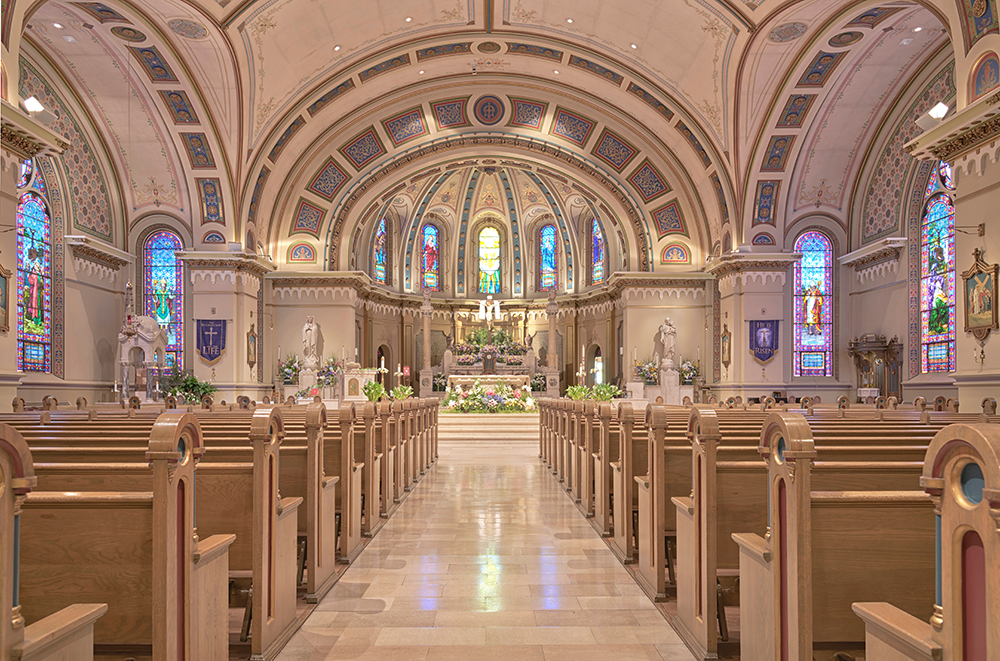
I was really uncomfortable at Mass last weekend. I was squished in my pew and had little room to relax. During the opening prayer, I could hear chairs being brought out. It was loud and distracting. But I was overwhelmed with joy.
The Church is growing. The Church is fulfilling her mission. It is One, Holy, Catholic and Apostolic. But what does it mean to say you are Catholic? This month, hundreds of future parishioners are attending the Rite of Enrollment and intensifying their prayer and studies as the Easter Vigil draws near. Because I am a teacher for some of those classes, and I get this question all of the time, I thought I would look at the word “Catholic” with OCIA in mind. Why are we Catholic? Where did that word come from and what does it mean?
The simple answer is found in Matthew 28:20 – “Then Jesus approached and said to them, “All power in heaven and on earth has been given to me. Go, therefore, and make disciples of all nations, baptizing them in the name of the Father, and of the Son, and of the Holy Spirit, teaching them to observe all that I have commanded you. And behold, I am with you always, until the end of the age.” In this verse, we find the Great Commission. We as Catholics are meant to be on mission, working to develop a relationship with Jesus and help others become disciples, followers of Jesus. These followers form the Church, Jesus’ body and bride. This Church is for everyone. It is universal. The whole world is called to be in love with Jesus.
In the Creed every Sunday we are also reminded of this important Catholic identity. The Marks of the Church – ‘One, Holy, Catholic, Apostolic – are recited as a benchmark, a reminder of our ancient faith linked to the Apostles. This word “Catholic” was first used around 110 AD. St. Ignatius of Antioch wrote a letter to the Smyreneans. In this letter, he is addressing problems in the community – some said the Passion of Christ was a sham, others were staying away from worship, and some were even creating schism. As a response to these factions that threatened the ‘Catholic’ nature of the Church, St. Ignatius reminds his readers to focus on what’s important – Where the bishop is present, there let the congregation gather, just as where Jesus Christ is, there is the Catholic Church.
In this letter we are reminded not only of the early presence and importance of Bishops, but we also see Jesus as the focal point of universality. Our Catholic Church, in all of its rites and traditions, is meant to point others to Christ. Signs and Sacramentals, Devotions and Novenas, all of these beautiful, ancient traditions find their purpose in illuminating what really matters – a relationship with Jesus.
The ‘universal’ nature of Christ’s Church is easily seen if you travel to another Catholic church on vacation. I have sat through Mass in another language and felt comfortable following along. Unlike other denominations, every Roman Catholic priest uses the same rubric at Mass. The prayers sound the same. We stand, sit and kneel at predictable times.
The term universal, however, is not the same as uniform, for local traditions may vary from city to city. It also doesn’t make our faith boring, for our Catholic list of saints keeps growing. Martyrs and millennials make up the list of former Catholics who lived heroic – not boring – lives of virtue. We are not robots, we are meant to be restless. After all, St. Augustine reminds us that ‘Our hearts are restless until they rest in you.’
Over the course of the next few weeks (until the Easter Vigil) candidates and catechumens will study the Catechism, grow in prayer and dive into scripture together. Together, they have been learning all of the beautiful traditions and celebrations that make us a Catholic, universal Church. During classes and meetings, they hopefully have come to appreciate the unique nature of what it means to be Catholic, part of a world-wide Church with thousands of years of beauty and wisdom, all pointing to Christ.
Last year at Easter, the Catholic Church recorded record numbers of new members. So far in 2026, the numbers keep climbing and all signs point to a record-breaking year again! At the University of Notre Dame, in particular, 2025 saw the largest group of converts in twenty-five years. Many cite COVID, a revival in our youth, the first American Pope, or even the internet for the increased numbers. Whatever it is, let’s continue to pray for continued conversion in our own hearts, our own homes and in our parishes. Together, this universal Catholic Church can reach ‘all the nations,’ as Jesus commanded.