
My wife and I work from home. Because of this, we are blessed to have our just-turned-three year-old daughter stay at home with us. As we type furiously on our keyboard while sitting on the couch, we periodically get a whiff of a pungent smell that is slowly permeating from the corner of the room. Our daughter has pooped, and my wife and I decide whose turn it is to change her diaper. It is a task that neither of us mind so there is rarely a disagreement on who should do it.
But now that our daughter is three, we both know that it is time to potty-train her. While the prospect of not changing diapers anymore is exciting, the task of potty-training feels a bit daunting. Letting our daughter do her business in a diaper fits well into our busy life that calls for efficiency. She does what she needs to do, we can take a moment to finish our task, and then we can change her. However, in order to potty-train her, we will have to drop all of our tasks immediately to help her.
Despite this minor inconvenience, we look at our daughter and out of love, desire her to be potty-trained. No human is meant to sit in their own fecal matter, even if it is for only a few seconds. Additionally, we care that she grows up to be a child who can function in public. Being potty-trained is one of the building blocks to a good life. And we know as parents who have already potty-trained our two oldest children, the other side is more freeing for both us and them when a child can take care of all of their bodily excrement by themselves.
In a way, today’s first reading relates to parents potty-training their children. The Israelite people have left the slavery of Egypt through God’s salvation at the Red Sea and are camped at the base of Mt. Sinai. Despite their freedom from physical oppression, their hearts were still enslaved by the idol worshipping culture they had just left. Their hearts needed to be potty-trained, and God looked on them with love and promised to make them His people; to make them more like Him. He ultimately does this when He gives the Israelites the Ten Commandments, Ark of the Covenant, and Tabernacle Tent. Even though the Israelites will have plenty of ‘accidents’ over hundreds of years and revert back into idol worship, God teaches His children how to grow up.
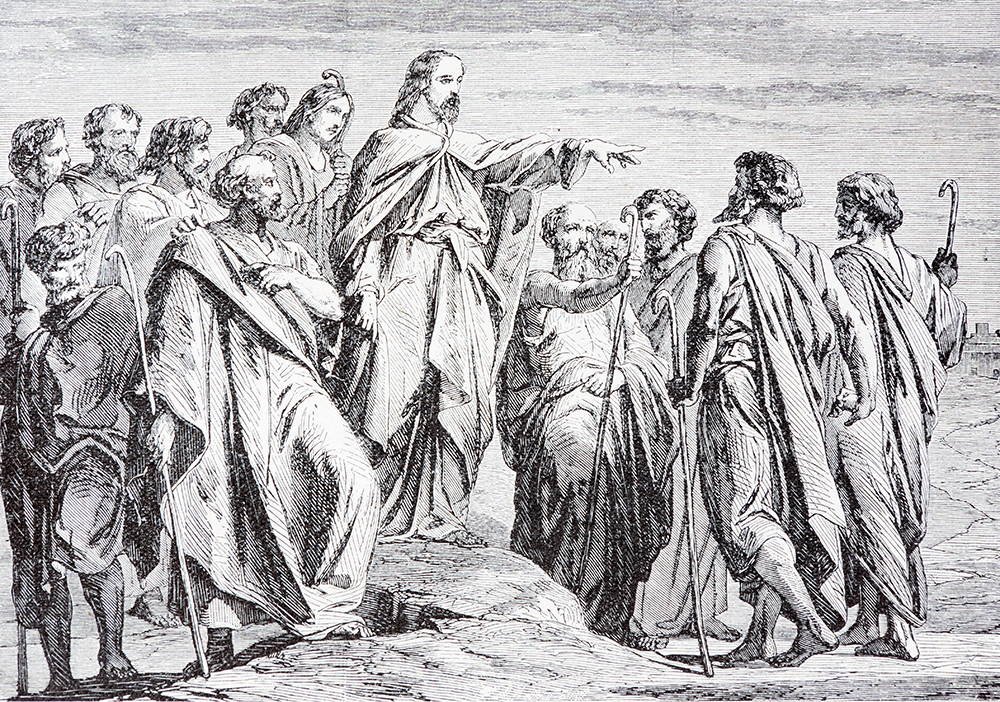
By the time Jesus arrives in the gospel hundreds of years later, the Israelites have been ‘potty-trained’. As a whole, their culture did not worship idols outwardly anymore. But growing up means to be proficient at more than just getting to the toilet on time. Now that Israel had mastered what it meant to be an independent child, it was time for them to grow further. In today’s gospel, Jesus looks on the lost people of Israel with love, and calls from them leaders who become His apostles. He instructs them to go out and tell all the Israelites about the Kingdom of God and to invite them into it. He also teaches them how to perform great signs and miracles in His name. In essence, He is teaching his mature now-teenagers how to ‘drive’, and He will do this so that the Apostles can teach the rest of us how to ‘drive’. He teaches them how to ‘steer’ the ship of the Kingdom of God, or the Church which He is trusting to them until His return.
The take away from the readings today is that God loves us too much to leave us to sit in our own refuse of idol worship. We are called to be something greater, and God can see that in us. Rather than always cleaning up after our ‘accidents’ (which God will always do when we let Him) He desires us to grow. Once this building block is secure, He will give us more responsibility and teach us how to ‘drive’ like He did for the Apostles. Despite this added work, there is also added freedom as we grow into who we were created to be. This Gospel reminds us that God has something in store for us far greater than we can imagine. Assuredly, the Apostles never dreamt that they would do the miracles they performed. Likewise we who are ‘potty-trained’ children of God are God’s children now; what we shall be has not yet been revealed. We do know that when it is revealed we shall be like him, for we shall see him as he is.