In the Old Testament, the Jewish priesthood centered around sacrificing animals as a means of worshipping God, singing God’s praises continuously, and maintaining the temple, God’s dwelling place amongst the Israelites. Even though this priesthood had its moments of holiness and splendor, it was imperfect and ultimately became corrupt. Yet when Jesus comes in human form, He lives the perfect life of sacrifice and praise to completion, even to His last breath on the cross. Because of this He is the true temple, God’s dwelling among us.
In His life, ministry, and death, Jesus exemplified the life of a priest as God intended it. Even though the tribe of Levi became the ministerial priests of the Israelites after the incident of the Golden Calf, it was not the plan that God had originally given to the patriarchs of Israel. God had desired that each head of household be the priest of his family, sacrificing their time, talent, and treasure to lead their family in loving their Creator. They were called to lay down their lives and fulfill God’s wishes by having humble and contrite hearts rather than sacrificing animals. Even though His ancestors failed to live up to this calling, Jesus was able to submit to God’s will perfectly and became the true high priest who can intercede perfectly for His family, the Church.
Yet, when Jesus leaves on Ascension Thursday, He promises not to leave us orphans. Rather the night before He died, He gave us His body and blood in the Eucharist and commissioned the twelve apostles to do the same in memory of Him. In a particular way, these chosen men were to take on the ministerial priesthood of Jesus, caring for and defending Jesus’ bride, the Church.
At Pentecost, these men were given the Holy Spirit to carry out this commission despite the impending persecution. As the Church grew under their priesthood, the apostles needed to hand on their ministry. They did this by laying their hands on their successors and praying for the Holy Spirit to fill new leaders, just as it had filled them on the morning of Pentecost. From this laying on of hands, three levels of ordination began to form within the tradition of the Church.
The first and highest level of ordination was a bishop. A bishop is a direct successor of the apostles. He governs a certain region within the Church and is charged with teaching authority and pastoring all of the souls within His region, regardless of their religious beliefs. He has the fullness of Holy Orders which means that he has the ability to administer or witness all seven sacraments.
The second and most common level of ordination is the presbyter or priest. These ministers are under the care of a bishop and are his representatives to a select group of people within the bishop’s care. The priest is able to normally administer or witness five (six in special circumstances) of the seven sacraments, but only with the permission of his bishop. The only sacrament that a priest is never allowed to administer is Holy Orders.
The third and lowest level of Holy Orders is the diaconate. Whenever the Apostles needed to continue to be missionaries and spread the Word of God in the early Church, they did not have time to be administrators of goods. So they laid their hands on seven ‘helpers’ that became the first deacons. Today, deacons still assist priests and bishops through works of service and mercy. They have the ability to baptise and witness marriages.
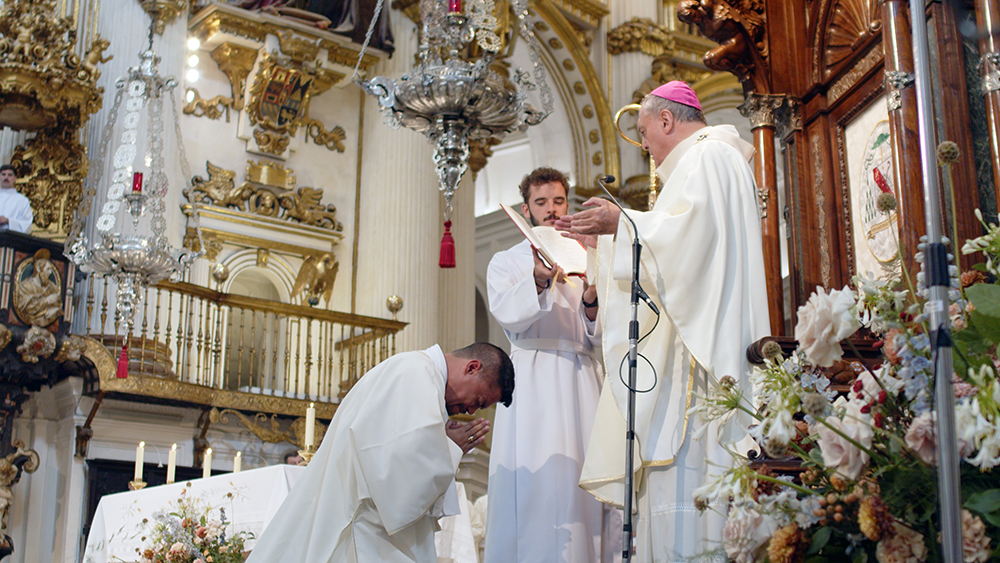
The matter of the sacrament of Holy Orders is whenever the minister lays his hands on the man being ordained. The form of the sacrament of Holy Orders is the consecratory prayer that accompanies the laying on of hands. The Minister of Holy Orders can only ever be a Bishop. When a man receives Holy Orders, he is first ordained a deacon. Then if it is his calling, he can be ordained a priest. Finally, if He receives the call from the Holy See, a man can be ordained a Bishop. Each level of ordination has its own unique rites, symbols, and prayers that confer the graces necessary for the office that is being fulfilled.
Despite all of the formalities behind different rites, ceremonies, and ministries, the priesthood at its core is the same that it was intended to be thousands of years ago when Adam was the high priest in the Garden of Eden. A man is called to lay down His life in service of others. Jesus emphasizes this call with His life and death, and when He calls His apostles on the night He gives them the priesthood to be at the service of one another. Sacrifice is the core of what it means to be a priest, and the sacrament of Holy Orders allows for the Catholic priest to live in the person of Jesus Christ, the true High Priest.