Possibly the oldest profession in the history of mankind is the priesthood. Since the beginning of time, the human race has been enamored with and felt a call to relate with the spiritual world and the divine. Consequently, nearly anywhere a society was established, a representative was appointed to speak to the spiritual realm on behalf of the people. This person was often a priest or priestess whose role as mediator was vital in the minds of the people because they facilitated the help of god or the gods which was often essential for survival.
As the priesthood developed over time in the ancient world, the common theme of sacrifice started to emerge in its execution. No matter how strange and even diabolical the sacrifice could get, there was an impulse within human societies that something must materially be lost by them in order to gain spiritual goods or protection. Societies tried to offer the most valuable thing to please their gods which was often blood, which they saw as the lifeforce within animals and humans. As a result, sacrifices were often made with a knife, on an altar, and offered in fire. It was a messy job.
The Jewish priesthood embodied these practices. Even though for the only true God, who led the Israelite people since the days of Abraham, priesthood was meant to be a sacrifice of spirit. Yet, the Israelite people proved time and time again that they were unable to sacrifice their trust to God and chased after the cultures of other nations who participated in profane and diabolical sacrifices. As a result, whenever God brought the people of Israel out of Egypt, they still preferred Egyptian idol worship. In response to this, God set up a sacrificial system and a priesthood that directly combated the ‘gods’ of Egypt that still had the hearts of His people.
As a merciful concession, God set up a physical place of dwelling with His people in the tabernacle tent. Here, God would meet with Moses and the Israelites would make animal sacrifices to God. These animals directly correlated to the ‘gods’ of Egypt as a reminder of God’s manifest power. He made the tribe of Levi, the tribe who defended His honor during the idolatry of the Golden Calf, the priests who would maintain the tent and the liturgies surrounding it. Eventually, the tent would turn into the temple in Jerusalem which became the place of worship for all of the Israelites who were faithful to God.
But this priesthood was imperfect. Even though it was guided by the true God, the sacrifice of animals would not justify the sins of the people. Consequently, sacrifices that were made day after day were never enough. A contrite and humble spirit was what God required, not the blood of goats and lambs. This was always His requirement from the days of Adam and Eve. Yet, it is easier to offer livestock rather than the heart, and God allowed the Israelites to continue this form of worship until He could send His Son to perfect their worship.
When Jesus came, He was born into the Jewish sacrificial system. His parents followed it whenever He was presented in the temple and Mary underwent her post birth purification. Yet, Jesus learned the true meaning of sacrifice through His obedience to His heavenly Father. As a result, His humble sacrifice of His Spirit resulted in the sacrifice of His own body and blood. This sacrifice of both body and spirit was rewarded with new life. And when Jesus ascended into heaven, He brought this sacrifice once and for all into God’s eternal holy temple. Thus, no more bloody sacrifices need to be made. Jesus’ sacrifice is sufficient for all people at all times because He can eternally intercede for all of those who approach God through Him.
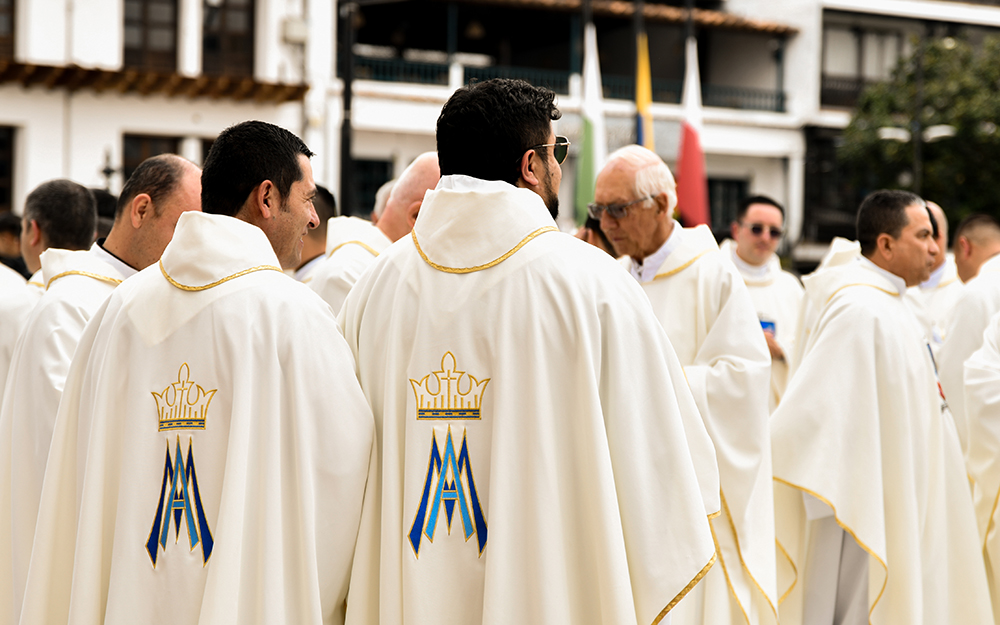
Even though this work was accomplished by Jesus years ago, He invited us all to enter into His sacrifice because a humble and contrite heart will bring us true peace and happiness. At our Baptism, we all are welcomed into the priesthood of Jesus. Yet, Jesus goes a step further and calls certain men to the Catholic ministerial priesthood to serve the needs of the people as He did years ago during His earthly ministry. He also gives them the ability to celebrate the Eucharist which makes present the eternal sacrifice of His body and blood. In this new priesthood, God abolishes the need for animal sacrifice ever again, and gives His people the ability to enter into the humble contrite heart of His Son. This true priesthood fulfills the longing of our ancestors because not only gives us the help that we need to survive in this life, but He allows us to enter into His family so that we can be with Him eternally in the next.