The sacrament of Confirmation can be a confusing sacrament. It can be seen as a tepid ceremony that is repetitive to the sacramental graces received at Baptism. Consequently, Confirmation can be seen today as a box to check on the way out the door of many young, soon-to-be no longer practicing Catholics. However, the treasures of Confirmation are much more than a rite of graduation within the Church.
Confirmation finds its roots in the Old Testament. Whenever a priest, prophet, or king was being designated for the service of God, they would be doused in oil and prayed over, asking God to send His Spirit upon the individual. As a result, the person became ‘God’s anointed’ who was set apart from the rest of society. Most famously, we see David selected and anointed as the King of Israel by the prophet Samuel.
In the New Testament, Jesus fulfills the duties of priest, prophet, and king, by making the ultimate sacrifice for our sins, being God’s Word incarnate for us, and by advancing the Kingdom of our heavenly Father on Earth. He is referred to as Jesus the ‘Messiah’ (Hebrew) or ‘Christ’ (Greek), which means ‘anointed one’ in their respective languages. We see that after His Baptism, Jesus receives the Holy Spirit as it comes down upon Him in the form of a dove.
Jesus then hands on His Spirit to the Apostles at Pentecost when the Holy Spirit descends upon them in tongues of fire. Fueled by the Spirit, the Apostles and all who were with them recieved the strength to advance the Church even through their martyrdom. The Holy Spirit was how Jesus advanced the Kingdom here on this earth, and it is the same Spirit that the Apostles used to convert the nations of the world.
That same Spirit is now handed down to us in the sacrament of Confirmation. Through the Apostolic succession that was handed down from the Apostles to each bishop through the centuries, we can receive Jesus’ Spirit in our hearts, mind, and souls to activate the same zeal for the faith as the early Church martyrs.
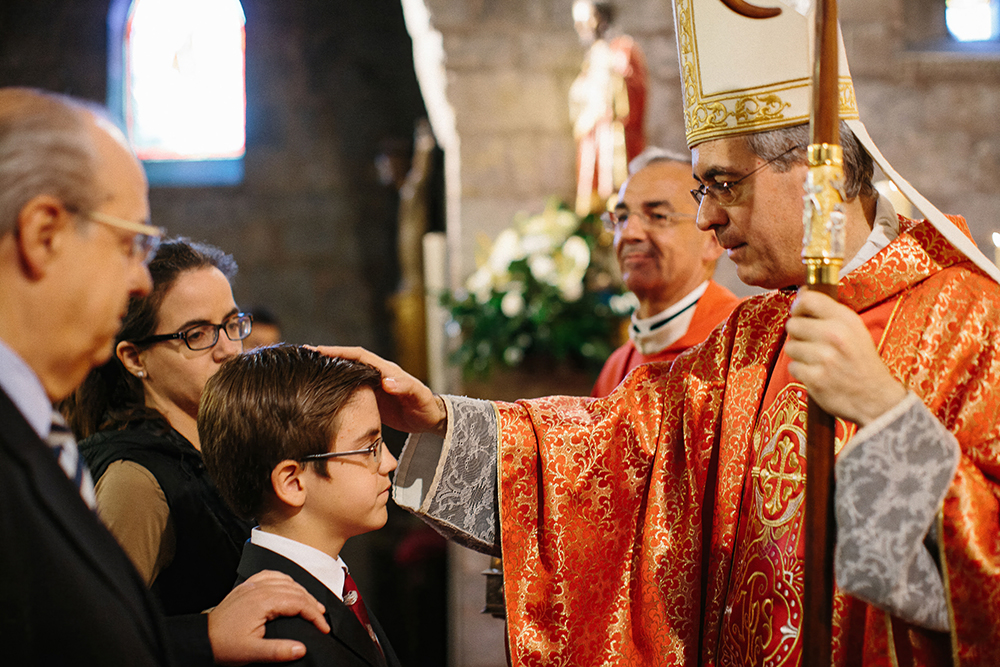
How do we receive the Holy Spirit in Confirmation today? The matter of Confirmation in the Roman Catholic Church is the Sacred Chrism oil on the forehead of the person being confirmed. The form is the words “Be sealed with the gifts of the Holy Spirit” while the minister anoints the forehead. The ordinary minister of the sacrament of Confirmation is a Bishop. However, in extraordinary circumstances, a priest can be given the faculties from his bishop to Confirm.
Those who are Confirmed receive the gifts of the Holy Spirit. These are Wisdom, Counsel, Knowledge, Piety, Understanding, Fortitude, and Fear of the Lord.. Just like all gifts, if you do not use them, or try to use them for something other than their designated purpose, they will be mostly impotent in the life of a Confirmation candidate. God gives us the sacrament of Confirmation to follow Jesus’ example of being priest, prophet, and king. If we are not intentionally doing this in our lives, then many of the gifts will be left unused.
But for those who do use the gifts of Confirmation, the path to sainthood is open. It is a difficult journey (thus God gives us gifts that will help us), but it will ultimately be one that will fulfill our purpose in life. The life of a saint is the answer to the modern confusion about the Sacrament of Confirmation. The saint burns with love for God, just as the first Apostles and disciples of Jesus burned on the day of Pentecost. Because ultimately our souls are on the path of transition from water (baptism) to fire (confirmation). This is the same path the world is on from Noah’s flood (water) to the second coming of Jesus (fire). And it is all to fulfill Jesus’ wish:I have come to set the earth on fire, and how I wish it were already blazing!