
I was once a Theology teacher at a Catholic High School. Because God’s path took me to another career, I left the school I loved working at, but stayed generally informed about the happenings in the school community. A few years after my departure, I was saddened to hear that a student who was a freshman my final year teaching at the school had committed suicide over homecoming weekend. I did not have any recollection of interacting with the student (I taught Juniors), but I had been aware of the students existence because of my involvement with student life.
The Monday morning after the event, I happened to have an errand to do right across the street from the school. Having some extra time, I decided to go say a prayer on site at the school for the student and the grieving community. School had been cancelled, and I fully expected to say some prayers from my car in the parking lot and then go about my day.
But as I parked, I suddenly started to see parents and students (many of whom I recognized and who recognized me) filing into the large outdoor tent in which the homecoming dance had been held. Unbeknownst to me, I had stumbled upon a rosary for the soul of the student. Following the prompting of the Holy Spirit, I went into the tent and sat in the back away from those who were grieving, but I said the rosary with them. At the end, some of the parents spoke about the situation, urging for hope and the tears began to flow.
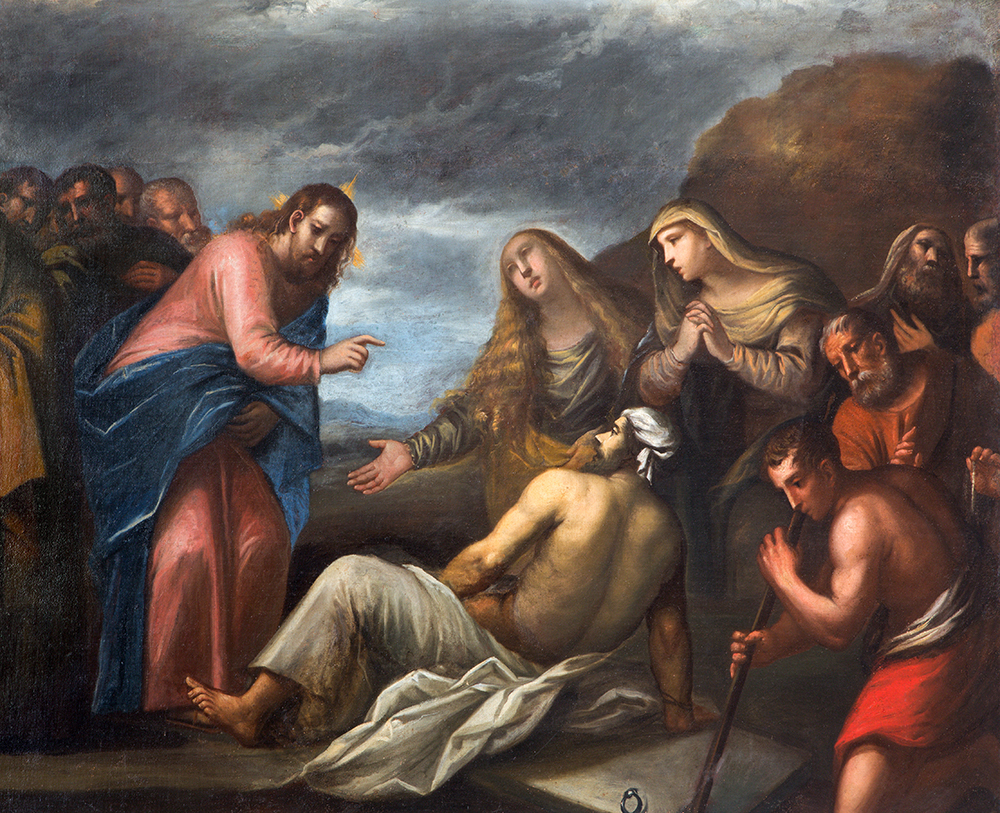
As I sat there, I was brought to the scene of today’s Gospel. Lazarus had died and both of His sisters confronted Jesus. Martha confronts Jesus first saying: Lord, if you had been here, my brother would not have died. But then she adds, But even now I know that whatever you ask of God, God will give you.
From the previous story of Martha in the gospels, we know that she likes doing the right thing. And in this moment, we can see Martha willing herself to have faith in Jesus, giving him the correct answer as an ‘A’ student would give their teacher in hopes that the outcome they desire will come to fruition.
Jesus answers in kind, as a teacher. Your brother will rise.
Martha continues the dialogue, continuing to prove her faith to the teacher. I know he will rise in the resurrection on the last day.
Jesus takes the moment to teach Martha further, I am the resurrection and the life; whoever believes in me, even if he dies, will live, and everyone who lives and believes in me will never die. Do you believe this?”
In response, Martha gave the answer of a good student. Yes, Lord. I have come to believe that you are the Christ, the Son of God, the one who is coming into the world. Martha treated Jesus like a teacher and received a teacher’s answer. Jesus’ answer was full of love, but Martha controlled the depth of their interaction to just be intellectual in nature.
But then Mary hears that Jesus desires to see her. She hurries to him and confronts Him with the exact same statement, Lord, if you had been here, my brother would not have died. She adds no other words, but falls at his feet, weeping. It is in this moment that Jesus becomes perturbed, and asks where Lazarus is. Once the Jews agreed to show him where the tomb was, Jesus openly weeps with Mary. Mary, who had treated Jesus as a brother, received the response of a brother. As a result, her interaction with Jesus was more intimate than her sister’s even though they began with the exact same statements of faith.
As I sat in the back of the tent that cold and rainy Monday morning, listening to the parents preach hope to the grieving students, I realized that had I still been a teacher there, it would have been my inclination to do the same: get up and preach as a teacher would. But the students were grieving. They were not looking for a teacher as Martha was. They were looking for a brother, as Mary was, and I found it most appropriate to silently grieve with them in the back of the tent. Sure, with my background, I could have given some theological speech most likely more eloquent than any of the parents, but Jesus teaches us in this story that a quiet, empathetic presence is often a better response to grief than any amount of words. The Jews did not react to Jesus’ teaching to Martha, but they did marvel at Jesus’ love when he weeps with Mary.
So as we draw closer to the day of Jesus’ death and resurrection, let us come to Jesus like Mary, approaching Him as our brother. Being a student like Martha is fine if that is where we are in our relationship with God, but if we desire deeper intimacy with our Lord, let us fall at His feet weeping. Let us give everything to Him. Because if we do, we will rise with Him, our brother, who is the Resurrection and the Life.